

It is a Wednesday afternoon in Sowcarpet, the dense, history-soaked trading neighbourhood in Vada Chennai (north Chennai), and the street smells like it always has — a little bit of everything happening at once. Diesel from an auto. The sharpness of raw onions from a food cart. Somewhere behind it all, something floral, something resiny, rising from a tiny shop wedged between a textiles store and a mobile repair stall. The shop sells attar.
The owner, a man in his fifties whose family has been in this business for three generations, lines up small glass vials on a worn wooden counter. He doesn’t need to ask what you want. He watches you for a moment, then asks whether you’re buying for a wedding or for every day. The question seems simple. It isn’t.
What he’s really doing is reading you — your clothes, your manner, whether you came in asking for a particular scent by name or stood there clueless. Your answer will determine whether he reaches for the oud-heavy, serious bottles meant for ceremony, or the lighter, citrus attars that have become popular with younger office-going customers who want something that won’t announce itself too loudly in an AC room. In that small navigation of occasion, identity, and aspiration, he is, without knowing the word for it, performing semiotics (the study of signs and symbols and their use or interpretation).
The Grammar of Smell
Scent is probably one of the most undertheorised social codes in Indian everyday life — which is strange, because we notice it constantly. We spend a lot of time analysing dress, food, and language as markers of identity — the way a silk saree signals occasion, the way a particular dish signals region, the way code-switching between Tamil and English signals class positioning. But smell is doing the same work, perhaps more quietly, and more powerfully, because we rarely think to interrogate it.
Think about what you already know, intuitively, about scent and belonging in India. The specific sandal paste smell of a Brahmin household on a pooja morning. The heavy, musky sweetness of oud that fills a Muslim home during Eid preparations. The sharp green of fresh flowers — kanakambaram, malligai — that Tamil women tuck into their hair and that forms part of the olfactory identity of Chennai itself, associated with femininity and an older way of being in the city. These aren’t just nice smells. They are signals. They carry information about who you are, where you come from, and what today means.
And then there’s everything that has happened to this language in the last twenty years.
The Mall Moment: When Scent Went Aspirational

Walk into Phoenix MarketCity in Chennai on any weekend and you’ll find, alongside the international fast-fashion brands and the food courts, a particular kind of perfume retail experience: shiny counters, backlit bottles in architectural shapes, salespeople in pressed uniforms who speak in English even when you address them in Tamil, and names — L’Occitane, The Body Shop, Forest Essentials, or local players like Nykaa Beauty — that signal a very specific aspiration.
What is being sold here is not just fragrance. It is a class identity, carefully constructed. Some sociologists who study urban consumer behaviour in South India describe a phenomenon that could be called olfactory migration — the way upwardly mobile Indian consumers move away from inherited scent practices towards international fragrance codes as a way of signalling arrival. Coconut oil and jasmine, attar from the neighbourhood shop: these get left behind, deliberately, as part of the cost of becoming someone new.
The women who turn up in focus group research on this subject are remarkably honest about it. The pattern that emerges repeatedly is a woman who loves her mother, loves what her mother smells like, and still makes a conscious decision not to smell that way at work. There is an enormous amount of class anxiety being quietly managed through the body. One version of this story that surfaces often involves a young IT professional on OMR who switched from jasmine-scented hair oil to a Dove dry shampoo after an offhand remark from a Western colleague about the strong smell of Indian offices. She could retell the story with a laugh. But the laugh did not quite reach her eyes.
The Ad and the Bottle: How Marketers Code Gender
Open any mainstream Indian perfume or deodorant advertisement, and the visual language is not subtle. Fogg, Wild Stone, Axe: the men’s range is almost always presented in dark packaging, angular bottles, copy that leans on conquest metaphors. Boss up. Dominate. The notes described in marketing copy are resolutely masculine in the most conventional sense — woody, leather, tobacco, marine. Even when a brand like Park Avenue tries something lighter, the language around it compensates through imagery: a suited man, a boardroom, a woman looking impressed.
Women’s fragrances get the opposite treatment: pastel bottles with curved, womb-like or floral silhouettes. Notes foregrounded in copy are floral, fruity, fresh — all coded soft, non-threatening, inviting. The Urdu and Hindi words that appear in marketing for traditional ittar lines — ruh, khushboo, mehek — are almost exclusively applied to women’s products or to devotional contexts, feminising and spiritualising the scent at once. When the same ittar appears in men’s marketing, the language shifts: the product becomes heritage, artisanal, authentic. The scent hasn’t changed. The social script wrapped around it has.
Creative directors who have worked on fragrance campaigns for Tamil Nadu brands describe how language-switching is almost always built into the brief. The aspirational tier gets English-heavy copy — even when the brand is Tamil and the consumer is Tamil. Switch to Tamil-only packaging, and you’ve already communicated to that consumer that this is the value product. It is an uncomfortable truth about the market, but it is the truth.
Ceremony, Community, and the Specific Weight of Oud
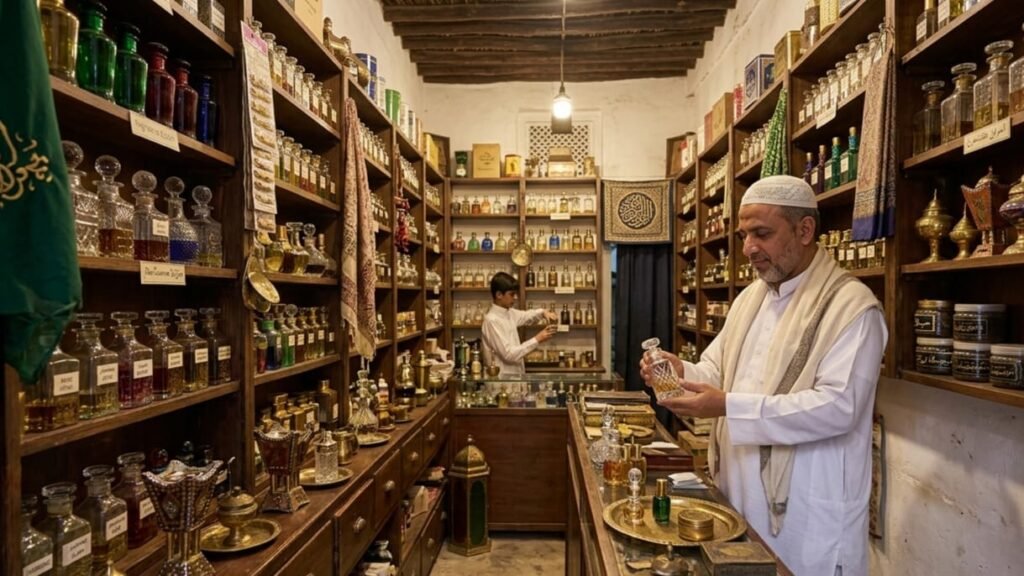
Back in Sowcarpet — which is predominantly a Muslim trading neighbourhood, its streets lined with shops run by Marwari, Bohra, and Memon families alongside Chennai’s older Tamil Muslim community — the ittar shop owner explained the difference between his most expensive oud and the ones he keeps near the front for casual browsers. The expensive one is for nikah. For Eid. For the big moments when a man needs to smell serious, generous, prosperous. Oud, he said, announces something about you before you speak. It says: I am someone.
This is not unique to Muslim communities or to oud. In Tamil Hindu households, the specific smell of sambrani — the resinous dhoop burned to purify a space, wafted over a new bride or a newborn — is so ceremonially loaded that it operates almost like a seal. A Chennai-based event photographer who has documented weddings across communities said he can identify, just by smell, walking into a hall, which community’s wedding it is. An Iyer wedding smells of camphor, agarbatti, fresh flowers — very clean. A Mudaliar wedding tends to be heavier, more perfume, more of everything. A Muslim wedding in the city almost always has oud and bakhoor. A Christian wedding sometimes has nothing at all, or something from a department store. The smells tell you who you’re with before you see the faces.
These are what semioticians would call olfactory landmarks — smell-memories that anchor community identity across time and geography. When a second-generation Tamil in London burns sambrani, it is not just nostalgia. It is an act of identity maintenance, a deliberate reaching back. And when a Dalit intellectual in Chennai chooses not to use the sandal paste his family used — or chooses to reclaim it — there is politics embedded in that choice too. Scent is never just scent.
Queering the Perfume Counter
The binary gender coding of Indian fragrance marketing has not gone unchallenged. Within Chennai’s small but visible queer community — concentrated in neighbourhoods like Nungambakkam and Anna Nagar, and increasingly online — scent has become a site of gender experimentation that the mainstream market is only beginning to acknowledge.
A 26-year-old non-binary graphic designer in the city described fragrance as the first place they got to simply exist without negotiating gender. They layer heavy oud — technically coded masculine in the Indian market — with floral top notes from the women’s section. The result belongs to no existing marketing category and no bottle on any shelf. That, precisely, is the point. For a trans woman in the same city, switching to fragrances marketed to women after transition was not a small thing, dressed up as a small thing. Every time she smelled like herself, it felt like confirmation — quiet, private, daily.
Some niche and indie brands — mostly online, a few with pop-up presence in Chennai’s boutique retail ecosystem around Alwarpet and Besant Nagar — are picking up on this energy. Gender-neutral fragrances with names that refuse to specify, copy that talks about mood and moment rather than her and him. It is a small shift. But in a category where the dominant language has been so aggressively binary for so long, even this feels like a rupture.
The New Ittar: Tradition as Luxury Good

There is a final, telling loop being completed in the Indian fragrance market right now. The ittars and dhoop and sambrani that urban middle-class consumers spent two decades moving away from — in their rush toward international brands, towards glass bottles with French names, toward the olfactory language of arrival — are coming back. But they’re coming back expensive.
Brands like Naso Profumi, Bombay Perfumery, and several Chennai-based indie lines are repackaging rose ittar, hina, and sambrani into minimal, expensive-looking bottles with English copy about ancient Indian tradition and retail price points that would genuinely horrify the Sowcarpet shop owner. The same scent, a different story told around it — and suddenly it is no longer the smell of your grandmother. It is a heritage. It is a luxury. It is aspirational in a new direction, the full circle of a class journey told through the nose.
The pattern is a familiar one. You abandon what you have. You pursue what you think is superior. And then, once you’ve arrived, you aestheticise what you abandoned — but at a price point that keeps the people you left behind from having it back. Scent is particularly good at this kind of cycle because it bypasses the rational mind entirely. You smell something, and you are somewhere, someone. The market has always known exactly how to exploit that.
Back in Sowcarpet, I bought a small vial of something the ittar seller calls Madina — a clean, white-floral scent traditionally worn by pilgrims on Hajj, he told me, but popular now with young men and women who want something light and daily. He wrapped it in cotton wool sealed it in a small paper envelope. I walked out into the afternoon heat, and the city smell immediately came back: diesel, flowers, dust, someone’s lunch.
But, on my wrist, something quieter. Something that, in another context, another counter, another bottle, another language, would mean something entirely different.
That’s the thing about scent. It always means something. We just rarely stop to ask what.