Odysseus Is The Villain, Nolan Just Won’t Admit It
Okay, so, let’s talk about the himbo problem!
No no no… we are not going to talk about Matt Damon. He has given everything he could to be the best man in the span of more than two and a half hours. The problem is Odysseus in 2026. Now, because somewhere between Homer’s papyrus and Christopher Nolan’s IMAX 70mm, Odysseus underwent metamorphosis, and I think people should talk more about it.
To support my argument here, I’d like to use some of my english literature knowledge that I got after reading a 450 to 600-page epic poem and its interpretations for examination: Odysseus is not a victim of the gods. Yes! He is the victim of his own ego (in literary terms, we call it “hubris”)! And, so, the ten years of taking a wrecking ball to the Mediterranean Sea along with his fellow mates? That’s not bad luck. That’s actually a punishment. Specifically. For something he did. On purpose. Because he could not help himself, his vainglory!
Time for a quick crash course for my people who skipped World Lit. a bit!
So…
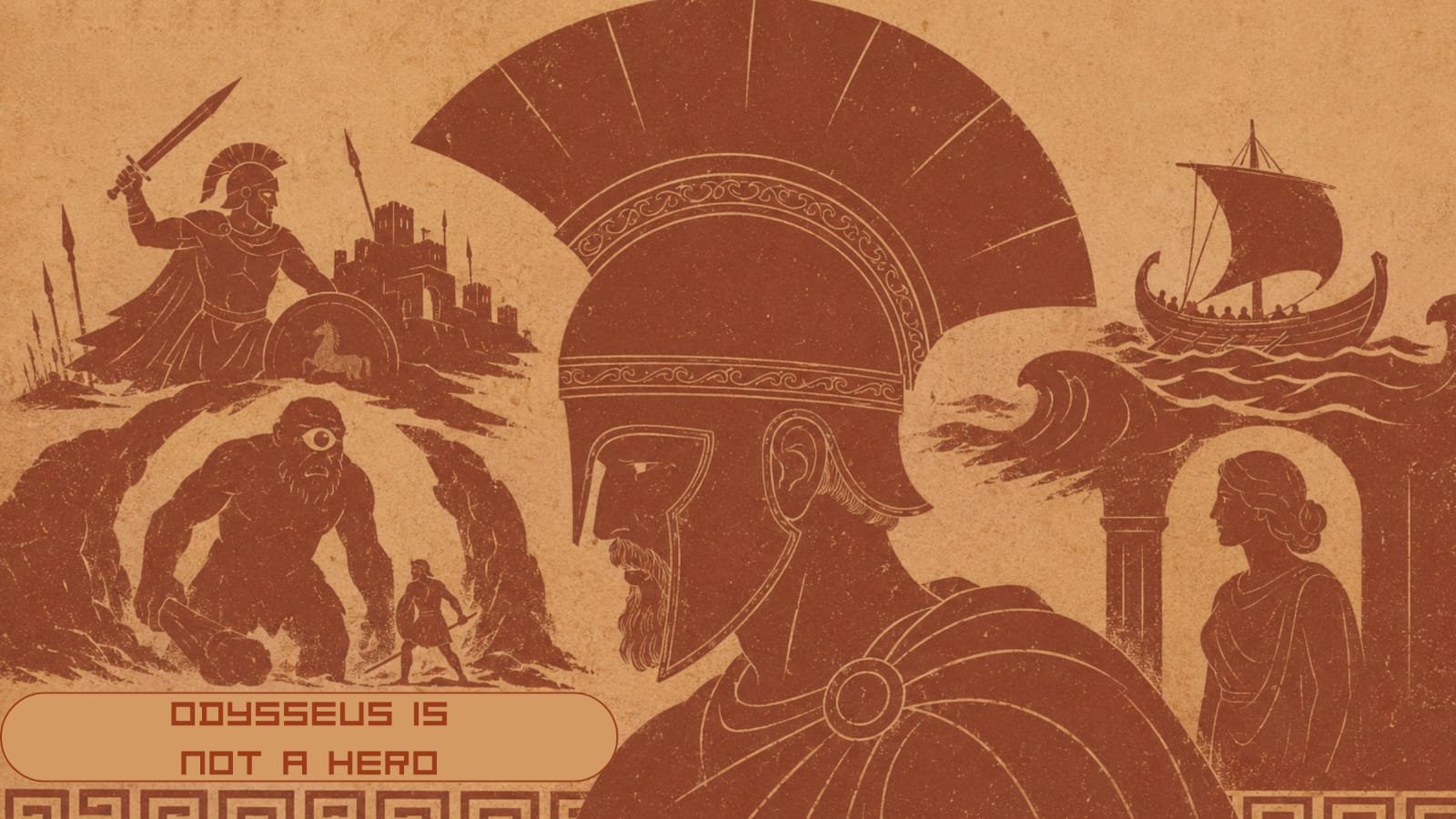
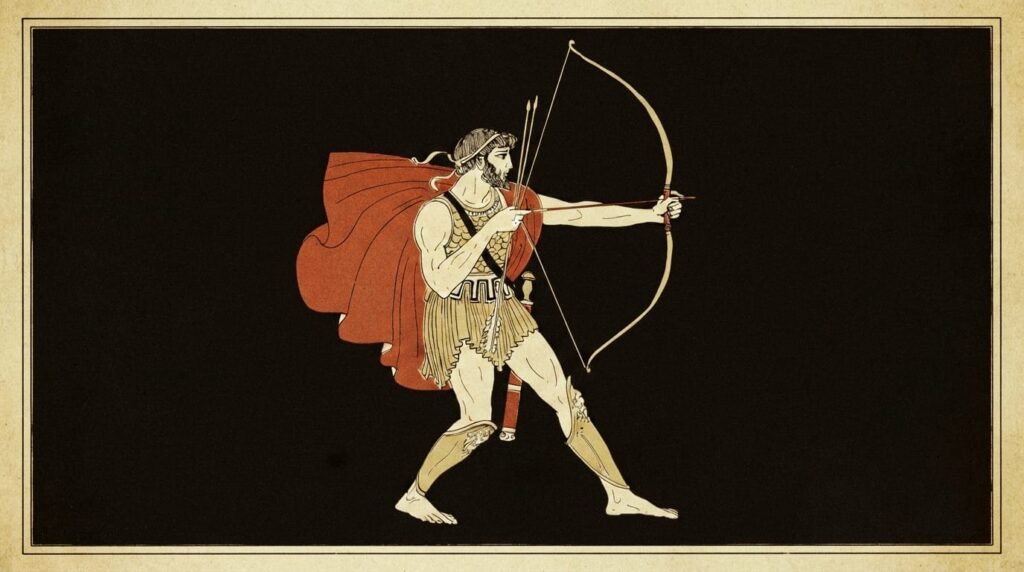
It begins with the ending of the Trojan War. Now, Odysseus, Greek war hero and the visionary of the Trojan Horse, wants to sail home to Ithaca from Troy, to his beautiful wife Penelope and his son. Should take a few weeks; it takes ten years instead…
And “this gap” is the entire book.
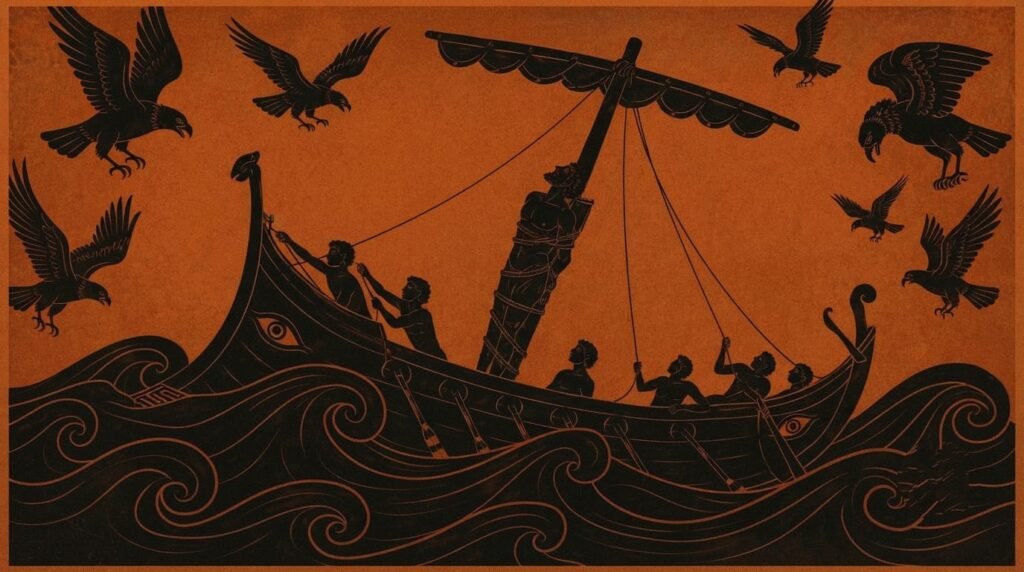
Now, along the way, he loses his crew one disaster at a time: the Lotus-Eaters, who feed his men a fruit that makes them forget they ever wanted to go home; Circe, a witch who turns half his crew into actual pigs; Scylla and Charybdis, a sea monster and a whirlpool he has to pick a lesser evil between; the Sirens, whose singing he survives only by having himself tied to his own mast; Calypso, a goddess who keeps him as a captive lover on her island for seven years. Every stop is a near-miss. Nobody survives the whole trip except him.
And back home the entire time, Penelope, his wife, following Zeus’ Law, is fending off a house full of suitors who have moved in, are eating through the family’s food, and are pressuring her to remarry because everyone’s assumed Odysseus is dead. Their son, Telemachus, grows up literally never having met his father. That’s the cost of the ten years!
“Zeus Law: The ancient Greek “guest rule.” Zeus (the Greek king of gods) was in charge of it, so if you treated a stranger badly, or a guest treated their host badly, it was seen as a big deal, almost like breaking a god’s law.“
It’s not just Odysseus’s problem; it’s everyone attached to him.
But the disaster that causes the entire chaos to go on for ten years instead of a few weeks happens right at the start, on the very first island they land on after leaving Troy. That’s the Cyclops!
Odysseus and his men get trapped in a cave by Polyphemus, a one-eyed cannibal giant who is, fairly, eating his men one by one for dinner. So Odysseus does something genuinely clever: gets the Cyclops drunk, blinds him with a sharpened stake, and tells him his name is “Nobody”. So, when Polyphemus screams for help, the other Cyclopes hear “Nobody’s hurting me!” and just shrug and go back to bed.
This is elite trickster energy. This is the move that should get taught in strategy classes. Anyway, Odysseus wins!
And, before we move ahead to appreciate him, he ruins it, too. Immediately. On the boat, pulling away from the island, safe, free, home practically in sight, he turns around and screams his actual name at the cyclops he just blinded. Literally goes, “It was ME. Odysseus. Son of Laertes. King of Ithaca. Tell everyone.”
I mean why! Why!! WHY!!! Nobody asked him to do that. His own men visibly begged him not to do so. But he did it anyway. Because he needed the credit? I think yes, he needed that a lot; he might have needed Polyphemus, the cyclops, to know exactly who humiliated him.
Now, in fairness to the guy (and this is the part that gets flattened when people just call it “ego”), Odysseus is not acting out of nowhere. He is operating inside a culture where kleos, glory, literally means “what people say about you after you’re gone.” That is not vanity to the original audience, but a currency. A hero who wins anonymously has not really won anything, because there’s no one left to sing about it. So when Odysseus screams his name, he’s making a genuine, high-stakes bet: immortal fame vs. the very real risk of divine payback. And he chooses fame. Which, honestly, makes it worse, not better (means the flaw isn’t a glitch in his character. It’s the operating system).
Turns out Polyphemus’s dad is Poseidon. God of the sea. The literal ocean the guy is about to spend the next decade sailing across. Suddenly Lotus-Eaters, Circe, Scylla, Calypso, all of it, has an author. It all traces back to the one thing nobody made him say.
So yeah. Ten years of shipwrecks, monsters, dead crew members, a wife fending off suitors, a son growing up fatherless – all of it traces back to one man’s inability to leave the chat without getting the last word in. Homer was not writing a tragedy that happens to Odysseus. He was writing a guy who is, structurally, the author of his own disaster. That’s the whole point of the scene.
Homer also frames the ten years as something closer to a trial by fire than a pure punishment. Odysseus doesn’t just suffer. He’s stripped of his ships, his men, his crown, his name, and has to slowly, humiliatingly earn all of it back before he’s allowed to walk into his own house again. So the ocean is not only Poseidon getting even. It’s also the thing that turns an arrogant war hero into a man patient enough to actually deserve Ithaca. The guilt and the growth are tangled together, which is a much more interesting story than “bad thing happens because of bad flaw.” It’s “the flaw gets beaten out of you, slowly, by the consequences of the flaw.” That’s the nuance a lot of retellings, Nolan’s included, leave on the table.
And then Nolan’s version just… doesn’t do that
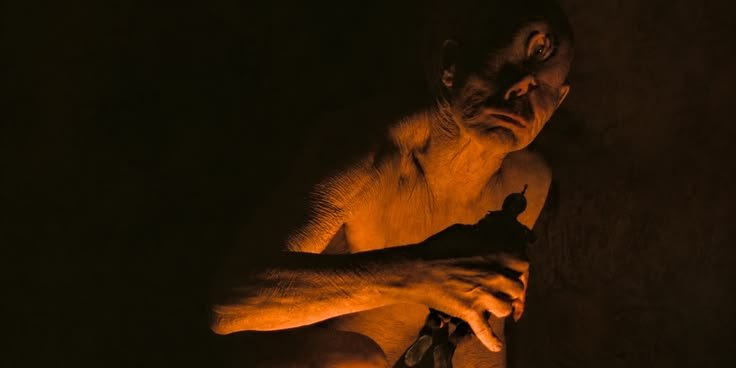
Here’s where it gets interesting. In Nolan’s adaptation (which pulls heavily from Emily Wilson’s celebrated 2017 translation and leans into a grounded, almost horror-movie realism for the Cyclops sequence), that beat just disappears. The film builds real sympathy for Polyphemus: he’s shot like something closer to a tragic, wounded creature than a monster who had it coming, and the emphasis shifts onto the horror of what Odysseus and his men do to escape, not onto Odysseus’s pride afterward. Nolan himself has said he wanted the audience “in there with Odysseus and his men,” treating it as “a horrifying situation” rather than a storybook set piece, which, fair, makes for a genuinely upsetting, well-crafted scene.
But notice what that framing quietly does. It keeps the horror. It cuts the hubris. Odysseus becomes a man who did something terrible to survive. Understandable, even forgivable. Instead of a man who did something terrible to survive, and then did something else, unforced, purely for his own ego, that turned survival into a decade-long curse.
That second part is the whole moral architecture of the myth. Without it, Odysseus is not a flawed man punished for his flaw. He’s just a nice guy having a really rough commute home.
And to be fair to Nolan: making Polyphemus sympathetic is not the problem here. Homer’s Cyclops is already more than a cardboard monster. He is a grieving father figure who talks to his sheep and begs his own dad for revenge. A film that leans into that is not betraying the source material. The issue isn’t that Nolan gave the Cyclops a soul. It’s that sympathy for the monster and guilt for the hero were never supposed to be a trade-off… the myth runs both at once, on purpose, so that you leave the cave not knowing entirely who to root for. Choosing one over the other isn’t a more faithful adaptation; it’s a simpler one. It’s also worth saying plainly: this is one scene in a nearly three-hour film, and it’s entirely possible Odysseus’s pride gets punished elsewhere… through Circe, through the suitors, through what he does or doesn’t tell Penelope when he finally gets home. If so, great, that’s the movie doing its job. But cutting the most explicit example of “his own mouth wrote this curse” and hoping the theme survives on vibes elsewhere is still a choice worth clocking.
This is a pattern, not a one-off
And look, I get it why nobody wants to sit in a $250 million IMAX epic and actively dislike the guy they have been told is the hero for two and a half hours. There’s also a genuinely reasonable filmmaking argument buried in here: a name-shouting monologue is a hard beat to land visually. It’s interior, it’s about ego and immortality, and it doesn’t naturally produce the kind of image a trailer is built around. Cutting it, or softening it, is not laziness. Sometimes it’s just what happens when a myth built for the ear has to become two hours of things you can see.
Source: Universal Pictures
But that’s a production explanation, not a moral one, and the two keep getting treated like the same thing. Modern blockbusters have basically decided that “flawed” is fine as long as it stays decorative. Give the hero a tragic backstory, a sad little flashback… sure! Give the hero a flaw that actually causes the plot, that means the audience has to sit with “actually, he kind of deserved some of this”? Way riskier. Way less merch-friendly.
“We like our heroes broken by the world, not by themselves. Guilt is stickier than tragedy.”
Tragedy gets you sympathy. Guilt makes you complicate the audience because if the hero’s downfall came from something as human and petty as needing to be seen, needing credit, needing the last word… that’s not a Greek myth problem. That’s all of our problem.
Homer wasn’t writing an adventure story with monsters as obstacles. He was writing a guy so addicted to his own legend that he’d risk his entire crew just to make sure the story got told correctly, with his name in it. That’s a cautionary tale.
And honestly? That impulse has aged well. We live inside a culture of receipts and credit and “sorry, for the algorithm real quick”. Odysseus turning the boat around to yell his own name into the wind is, structurally, a guy who couldn’t let the story exist without a caption. Three thousand years later and we’d probably still be doing it, just with worse lighting.
So did Nolan chicken out?
Maybe “chickened out” is a harsh term. Maybe it’s more that Nolan – a director who has spent his whole career fascinated by men undone by their own obsessions, their own control issues, their own refusal to just let something go – had the exact tools to tell this version of the story, and chose the safer cut instead. And to give credit where it’s due: this is the same director who let a man drown his own timeline in guilt in Memento, who let obsession quietly wreck two lives in The Prestige. He is not allergic to unlikable protagonists. Which makes this omission more notable, not less. The guy clearly knows how to sit an audience down next to someone they should not fully forgive. He just didn’t do it here, with the myth that basically hands him the blueprint for free.
The one where Polyphemus gets our sympathy but Odysseus doesn’t have to earn our disappointment.
Which is a shame, honestly, because the original ending hits so much harder. Homer’s Odysseus does not get to be the guy the gods picked on. He’s the guy who had the win, had the exit, had everything and blew it up himself because his ego couldn’t stand to leave anonymously.
THE
GOODDAY POST
CREDITS
Priya Biswas
Author
Hassan
Editor
M Khizar
Editor
Dimpy Malviya
Contributor
Support Us
We believe happiness is contagious. Your support allows us to keep digging for the stories that restore faith and spark a smile.