
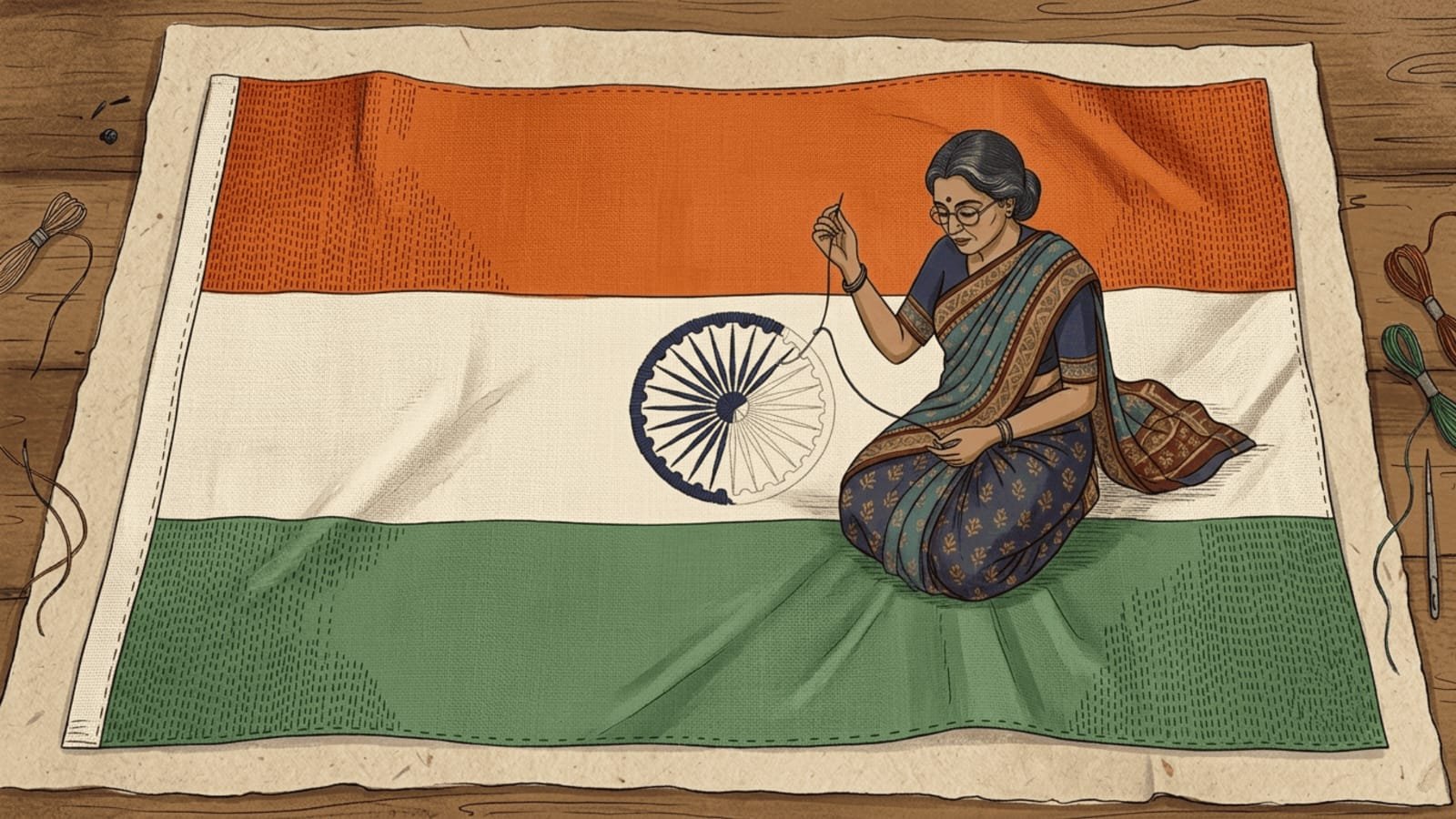
We’ve all seen the Indian national flag countless times: the tricolour where saffron, white and green come together with navy blue Ashoka chakra.
It is widely believed that the national flag was presented by Pingali Venkayya to Gandhi Ji in 1921, yet some historians like Captain L. Paduranga Reddy have argued that the officially accepted version is the contribution of Surayya Tayabji. In this article, we will try to decode this mystery alongside finding out who Surayya Tayabji actually was.
From the Parliamentary archives, we found that Suraiya Tyabji’s name was indeed on the list of members of the Flag Presentation Committee who presented the national flag on Aug 14th, 1947. But this documentation does not confirm whether she designed the national flag or not.
Some researchers from the Flag Foundation of India argue that Surayya Tayabji’s final version of the design is the one approved by the national assembly. British historian Trevor Royale, in The Last Days of the Raj, even wrote that “by one of those contradictions which run through India’s history, the national flag was designed by a Muslim.” The line sparked renewed controversy.
Shree Laila Tyabji, daughter of Surayya Tayabji, wrote in The Wire, “ How the tricolour and the Lion emblem really came to be”. The tricolour designed by Pengali Venkayys, with the charkha, was assumed to become the national flag before independence. This surfaced with the controversy of the party flag becoming the national flag. She said that her father, Badruddin Tyabji, had set up a flag committee headed by Rajendra Prasad on the instructions of Nehru. Badruddin Tyabji was then working as an Indian Civil Service officer in the Prime Minister’s Office.
Surayya Tayabji, wife of Badruddin Tayabji and official member of the flag committee, added the Ashoka chakra from the Lion capital of Ashoka, replacing the Charkha on the 1931 version of the flag. This final version of the flag became the symbol of national unity and was officially adopted on the eve of Independence on 15 August 1947. Surayya Tayabji’s version of the national flag flew on the car of Prime Minister Nehru on Independence Day.
Her story is rooted in a remarkable legacy. She was the niece of the Prime Minister of Hyderabad, Sir Akbar Haydari (1937-1941). Her grandmother, Lady Amina Hydri, worked for women’s education in Hyderabad. This made her forever exposed to patriarchal supremacy.
Even though Surayya Tyabji’s extent of contribution to the national flag remains an unsolved mystery, Surayya Tayabji’s artistic devotion and contribution to Indian independence are unquestionable. It shows that Indian women’s engagement in shaping the unity and integrity of this country has been indelible since the birth of the nation.