
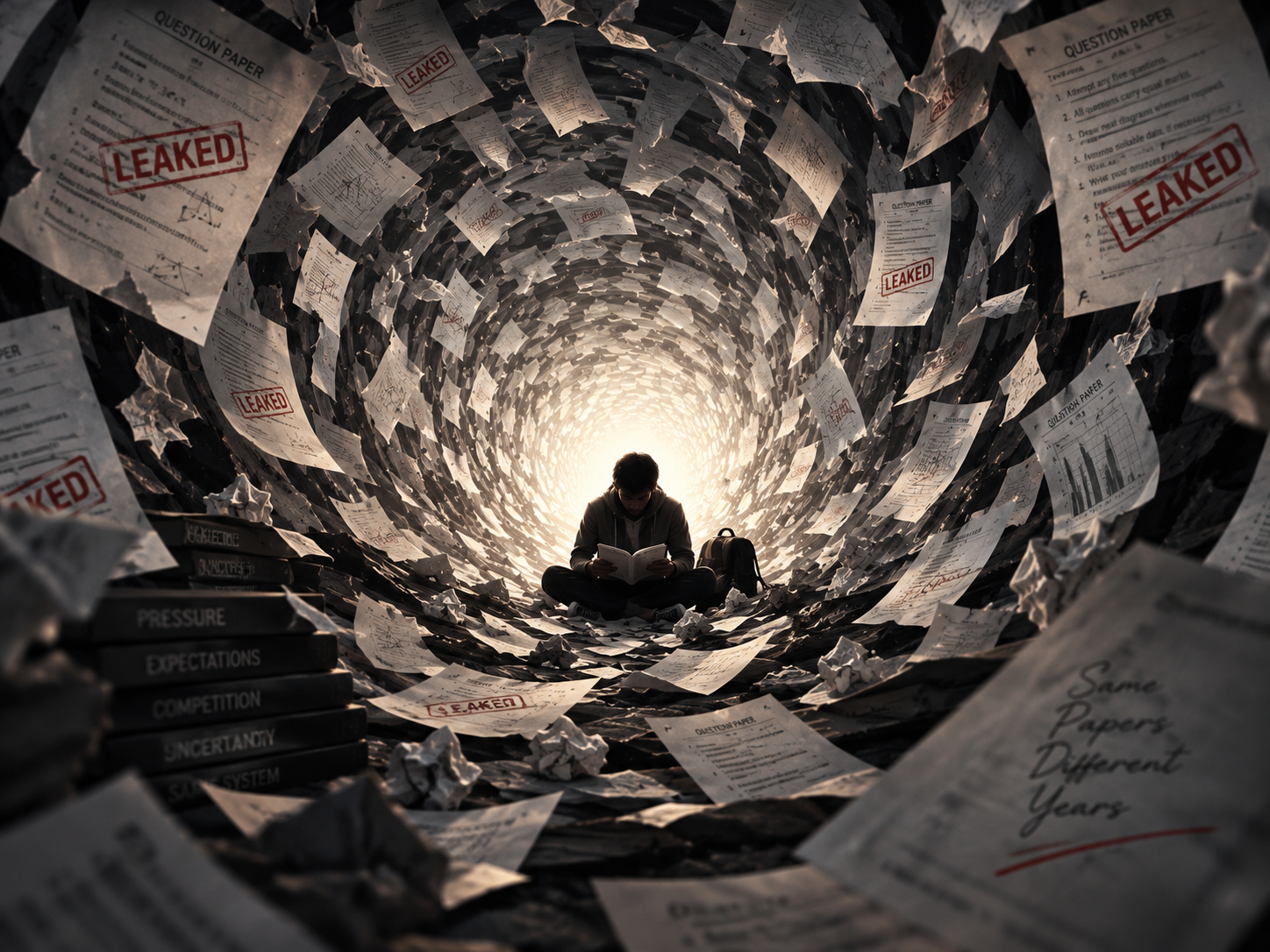
A NEET paper leak sounds like a simple crime.
Someone gets the paper. Someone sells it. A few students benefit. Everyone else loses.
But the NEET-UG 2026 case was far messier than that.
More than 22 lakh students sat for the exam on3 May. Nine days later, the National Testing Agency cancelled the entire examination.It was the first time NEET-UG had been cancelled nationwide since the exam began in 2016. A re-examination was eventually held on 21 June.
But the more pressing question is not why the paper leaked.
It is how a question paper moved from a tightly controlled examination system into the hands of students, brokers and sellers without anyone stopping it.
Because once you look at the chain, you see a pattern, and that is horrifying. The first version of the story was familiar.
A 410-question document started circulating in Rajasthan. Around 120 questions reportedly matched items that appeared in the actual NEET paper, and apparently that was enough to trigger an investigation and eventually the cancellation of the examination.
But there was a strange detail.
According to the CBI’s investigation, P.V. Kulkarni, a chemistry lecturer involved in the examination process for the NTA, had access to the question papers. In the last week of April, he allegedly organised special coaching sessions in Pune, where he dictated questions, options and answers to students. The students wrote them down by hand; those handwritten questions later matched the actual paper.
There was originally no need to photograph a question paper and upload it somewhere. Information itself was enough.
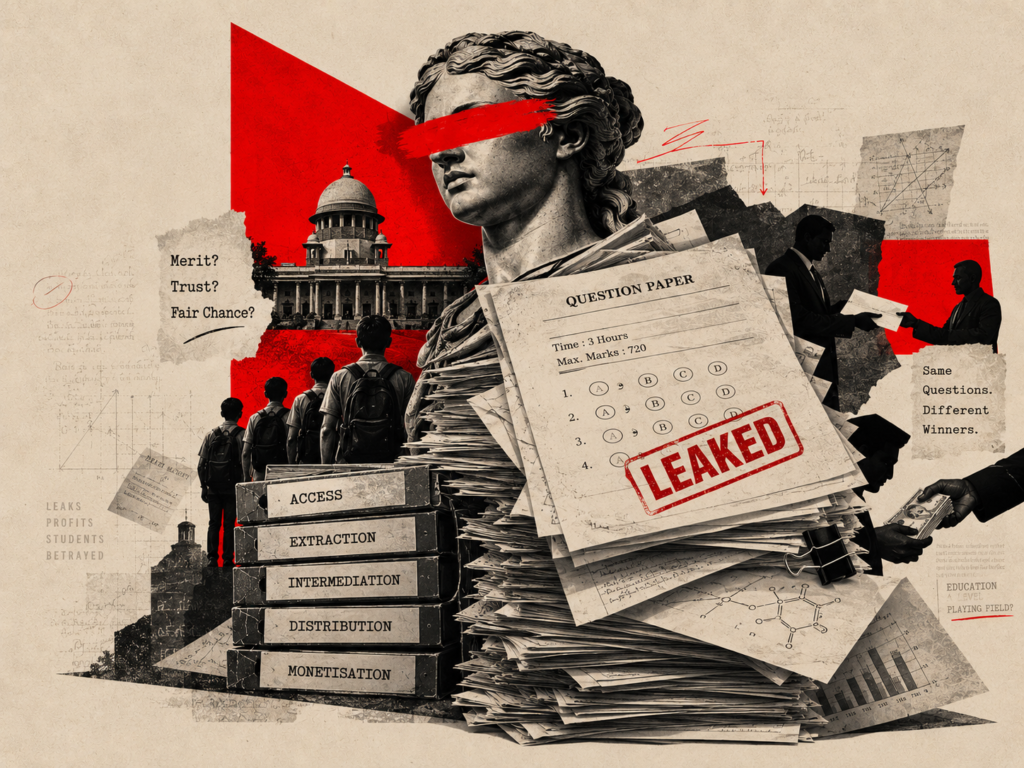
To understand the issue better, think of the leak as a five-stage supply chain.
Access → Extraction → Intermediation → Distribution → Monetisation.
At the first stage sits someone with privileged access.
That person does not necessarily need to steal anything. They only need enough access to reproduce valuable information.
Then comes extraction.
The information has to leave the protected environment. In the NEET case, investigators allege that they dictated questions during private coaching sessions and that students reconstructed them.
That created a strange loophole: the confidential material could leave the system without a conventional digital copy of the paper leaving with it.
Then comes intermediation.
The person with access is rarely the one who knows thousands of desperate students. Someone else has to find buyers, collect money and move information.
That is where the network becomes valuable.
Investigators traced the 2026 case across Maharashtra, Haryana and Rajasthan, with several intermediaries allegedly involved in moving the material to prospective beneficiaries.
The CBI eventually arrested 13 people and filed a chargesheet alleging offences including criminal conspiracy, cheating, breach of trust, destruction of evidence and violations under the Prevention of Corruption Act and the Public Examinations (Prevention of Unfair Means) Act.
This is not how a random act of cheating behaves.
A leaked paper has almost no value to the person who already has it; its value comes from scarcity. More than 22 lakh candidates competed for medical seats in 2026.

Every time a leak happens, the solution tends to become more technology, but NEET 2026 shows why technology alone cannot solve the problem.
In August, the CBI flagged major security shortcomings in the NTA’s examination preparation. These reportedly included inadequate CCTV coverage, weak security controls in the confidential section and the repeated involvement of the same group of people across different stages of question-paper creation and finalisation.
The problem, therefore, was not simply that someone hacked a system. It was that the system gave certain humans valuable access and then relied heavily on their integrity.
In May, the NTA told a parliamentary committee that the alleged leak did not originate through its internal system.
But by August, the CBI had filed a chargesheet alleging that three NTA subject experts had breached their confidentiality obligations and circulated confidential examination material.
When millions of people compete for a limited number of opportunities, information that provides even a small advantage becomes extremely valuable.
“The leak is simply where that value becomes criminal, but who actually pays? Apart from the students, the system? Their parents?”
An exam works because everyone agrees to believe that the person with the highest score actually performed better. Remove that belief, and the marks become numbers on a screen.
This is why cancelling NEET 2026 was bigger than cancelling one examination.
The NTA had to effectively tell more than 22 lakh candidates that the result of the test they had already taken could no longer be trusted.
The honest candidate was asked to pay for someone else’s fraud with another afternoon, another round of anxiety and another gamble.
It is evidence of a system where the pressure to win has become so high that information itself becomes a tradable asset.
The CBI’s investigation has now mapped a network of alleged insiders, intermediaries and beneficiaries. But arrests alone cannot eliminate the economics that created the demand in the first place.
The real fix therefore cannot be another camera in another examination room.
It has to make privileged access harder to monetise, reduce unnecessary human exposure to confidential material, separate responsibilities so that one group cannot dominate multiple stages of paper creation, create stronger independent audits, and make the consequences of being caught greater than the expected payoff.