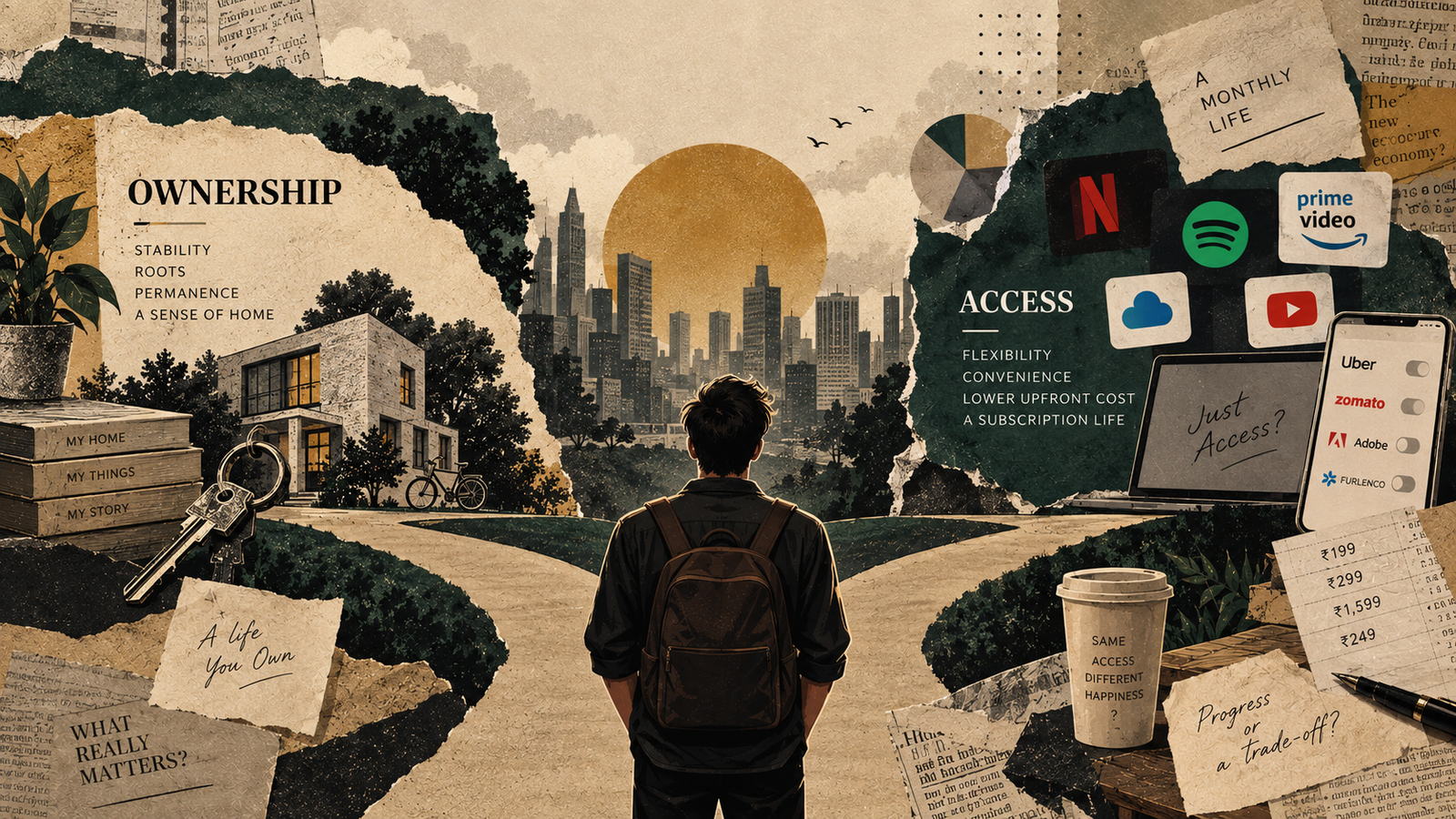
In the mid 2010s, a phrase broke the internet, “You’ll Own Nothing, And Still be Happy.” What made it controversial is that this phrase didn’t come from some random person, but from the World Economic Forum. The phrase was based on a 2016 essay by a Danish politician, and was reused by the forum under the article “Welcome to 2030.” But is that even real? I prepared a list.
Netflix, Spotify, Amazon Prime, cloud storage. I stared at that list for a long moment.
Since then, the phrase and the list has been hitting me hard. Since childhood, I had dreamt of owning my favourite things. Downloading my favourite movies and songs, owning a bicycle, a bike, etc.
But today, every single thing on it gave me access to something, but none of it was actually mine. And I am not alone in this. I bet somehow you’re also in this situation. Somewhere between my father’s generation and mine, the world rewrote the contract between people and the things they use. It just forgot to tell us. Mostly everything now is either leased or offered in a subscription model.
Apart from these subscriptions, there are a lot of other things that I have rented instead of owning them. The study table I write on, the lamp that lights my room at night, both belong to a company that will send two men to take them back the moment I stop paying. Like many of you, I also use Ola to get somewhere and sometimes Zomato to eat something. To earn an extra income, I freelance and use Adobe to create something (except I don’t use Adobe, I subscribe to it), which means the moment I stop paying, every file I ever made becomes a hostage.
All these things might have sounded wrong 15-20 years back. But now, it all works beautifully.
This trend of access over ownership is now immensely popular among Gen Zs and even Millennials. Subscription has been such a successful model, that a new study by global tech strategists Juniper Research has found that the subscription economy will grow by 67% over the next five years; from $722 billion in 2025.
But why so? Let me tell you why it works for me. I press a button and a cab appears. I press another and dinner arrives. I opened Spotify and fourteen years of recorded human music is just there, waiting, at ₹199 a month. There are mornings in this city, stuck in traffic on Outer Ring Road, earphones in, some perfectly curated playlist doing its job, where this life feels nothing short of miraculous.
However, there is another side to it. Recently, when I left my place after spending the past fourteen months in my house, I packed in less than two hours. Not much in that room, it seemed to me, was mine. I packed two bags, booked an Ola, and that was all. Fourteen months. Two bags. One cab.
It should have felt efficient, but beneath that was something unsettling. Even after spending more than a year there, I had not left any record of my existence. The world would take my place in that room, and nothing would be recalled about that room that I had ever lived there too.
I suppose that is what ownership makes you quietly have, a proof that you were here.
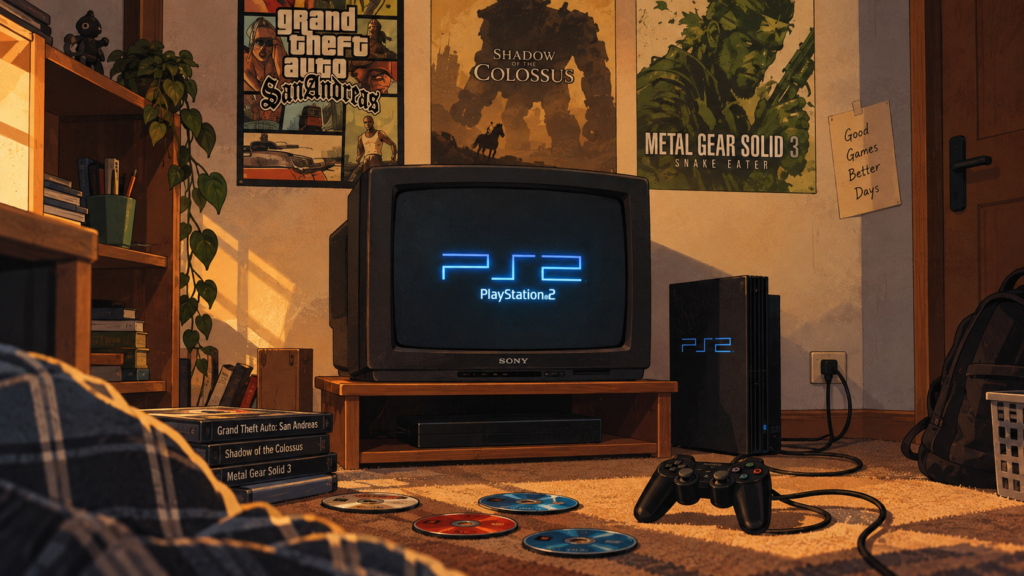
“My dad once took three weeks to research what TV to purchase. This TV survived two governments and one cricket world cup.” It had a personality. Whereas I have a Netflix account that has better content, and I am just one password policy away from losing it. Unlike that television, nothing that I visit today will recall me back.
It was between doom-scrolling and half-watching something I had watched before that I came across a line that paused me halfway through the scroll.
You will have nothing to own, and will be happy.
Some people were outraged. Some were laughing. I just sat with it for a moment. On account of which, as it turned out, no one in that comment area was disposed to confide, because it did not sound like a threat to me. It was as though it were a description. An almost boring description of the life I was already living, in a quite accurate way.
“I own nothing. And most days, I am happy.” That’s the part that unsettles me more than the line itself.
There’s an entire economy that rebuilt itself around people like me. Businesses figured out that a customer who pays every month is infinitely more valuable than one who pays once and disappears. Adobe stopped selling Photoshop outright because ₹1,600 a month forever beats ₹25,000 once. Streaming replaced music stores, video stores, and cable television in what felt like a single exhale. Car companies are now piloting subscription models. Furniture rental startups like Furlenco built entire businesses on the idea that people like me don’t stay anywhere long enough to justify owning a sofa.
And my revolving around just 2-3 examples does not mean it’s limited. There’s a whole ocean of such services.
Research keeps pointing to the same thing, younger generations consistently prefer access over ownership. Before anyone calls it laziness, the more honest reason is math. Housing prices in Indian metros have made ownership a distant, theoretical goal. Flexibility isn’t just a preference anymore. For most of us, it’s the only practical option.
I also wonder sometimes if minimalism, this clean and photogenic philosophy, is partly just a beautiful story we started telling ourselves once ownership became too expensive to romanticize. It’s easier to call something a philosophy when the alternative is simply out of reach.
“So I find myself back where I started. Sitting on a bed I don’t own, in a room I’m borrowing, in a city that has never pretended to belong to anyone.”
You’ll own nothing and still be happy.
The part that lingers isn’t the nothing. It’s the still. That tiny word carries the entire conflict of a generation inside it, acknowledging the absence and asking you to make peace with it anyway.
Maybe this is just what growing up looks like now. Maybe lightness is the most honest response to a world that changes faster than furniture can be paid off. Or maybe there is something quietly important about ownership that we haven’t found a subscription for yet. Something about permanence. About leaving a mark on a wall that says you were here, that this particular corner of the world knew your name.
I don’t know. I’m twenty-three, living in Delhi, and most of my life is stored in the cloud.
But sometimes, on Tuesday nights, I close my payment history and just sit with the question.