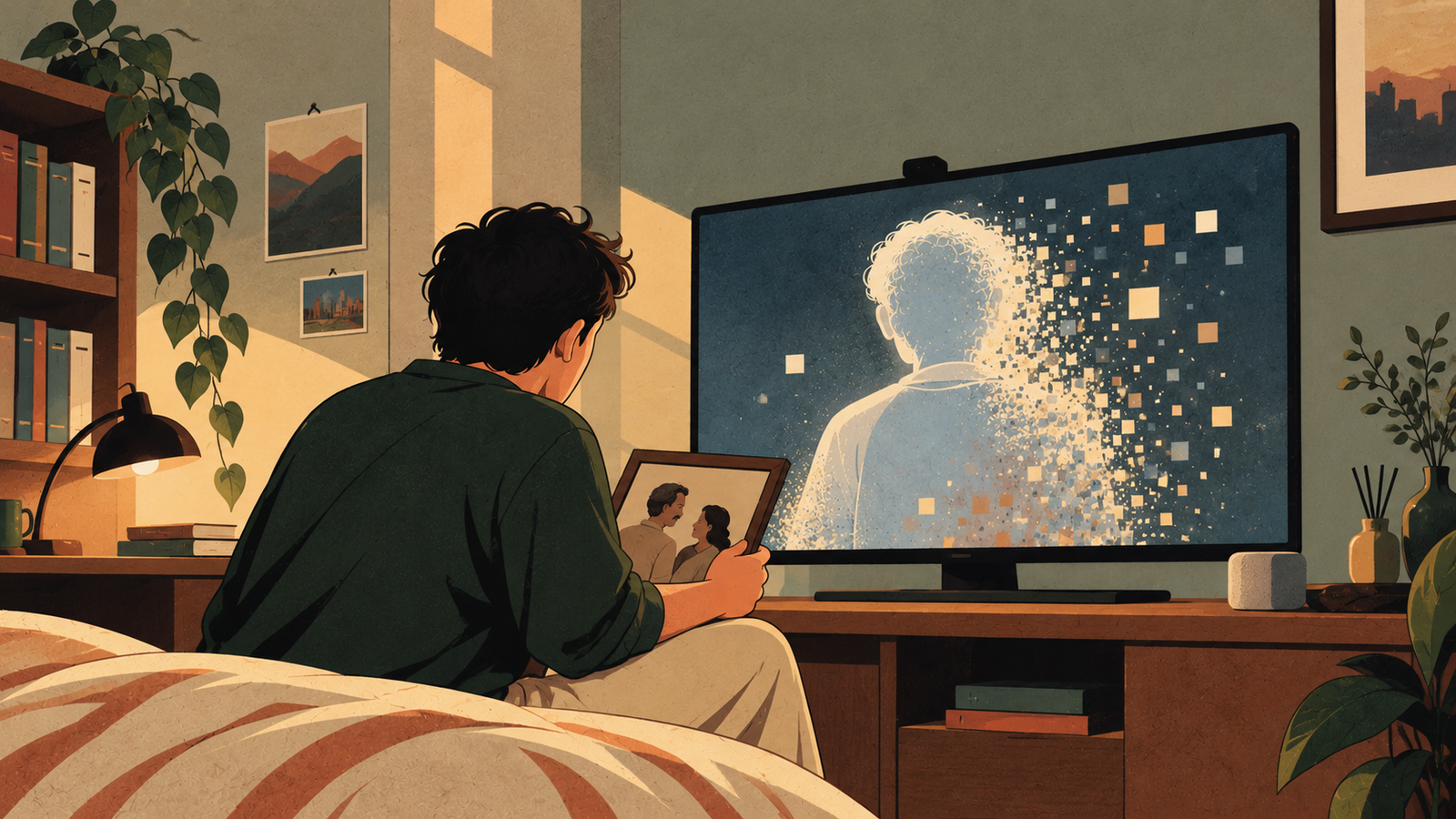
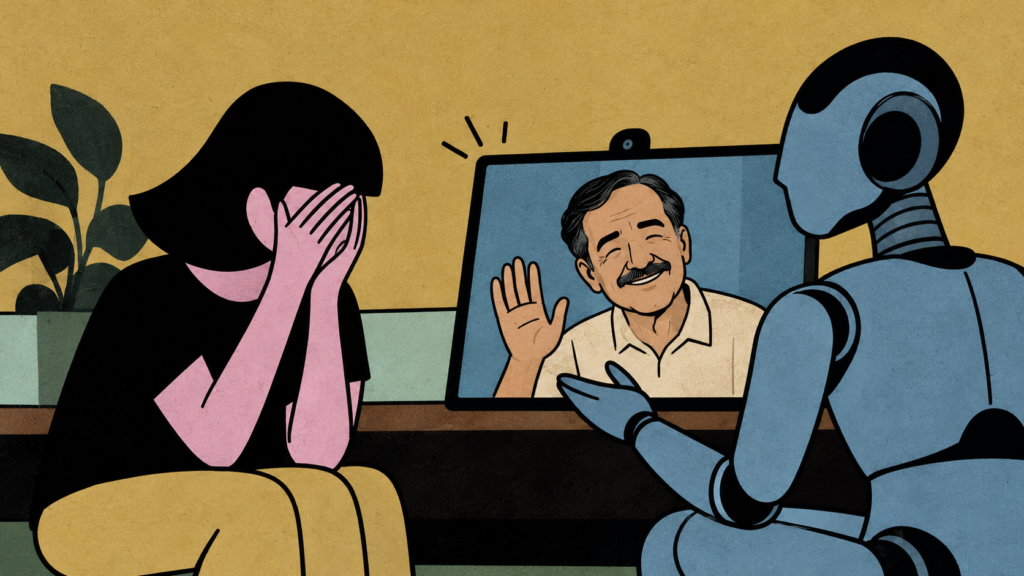
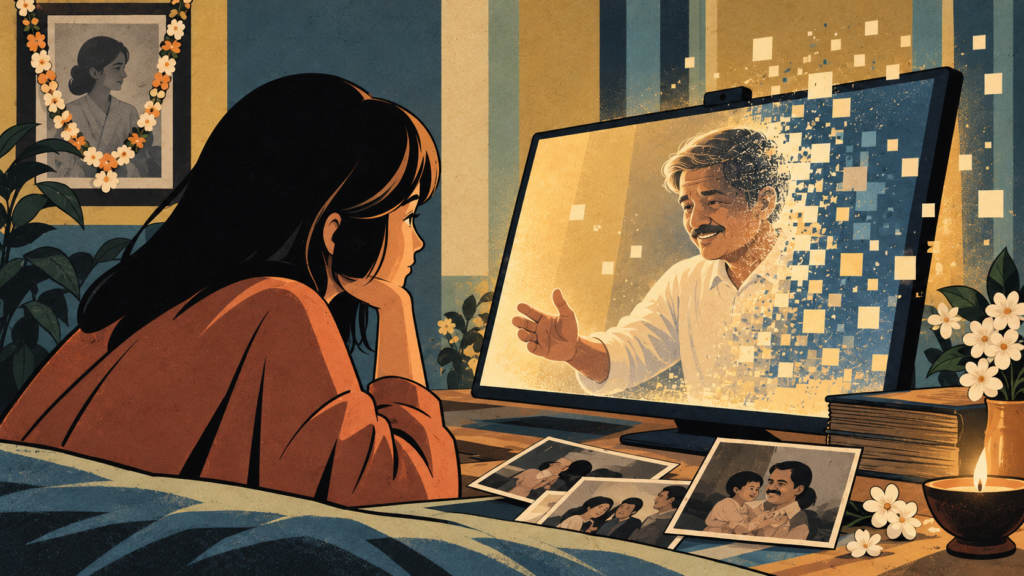
Imagine yourself in a prayer meeting, silently mourning the death of your dear one whom you lost many years ago, and suddenly they start talking to you. Not through remembrance or imagination, but on a screen in front of you, looking at you, sounding like themselves, thanking you for coming there.
Grief stands still and reality gets blurred in that moment. The impossible is no more there; it’s no more a fiction. And in that momentary pause, an idea strikes you, what if you got to see your dear one again, heard their voice again, felt their presence again, and got a moment again that life didn’t give you?
In India, artificial intelligence is invading this one of the most personal and sensitive aspects of human life: loss.
What was once limited to photographs and fading audio recordings is now evolving into an experience that is much more vivid and personal. The deceased are no longer merely honored in death; they’re being brought back to life.
During a recent memorial event, an experience like this had left all attendance visibly moved. Saurabh Jain, who is a Chartered Accountant by profession and an EdTech entrepreneur, took to social media to recount how an AI-generated video had included an appearance by his late uncle on screen, where the latter had spoken from his heart, thanking everyone who had turned up. Such an experience had seemed “incredibly real” due to the realism of the video.
There was a sense of wonder in this moment, but it also showed how technology is starting to change the way people think about loss. It provides a space where memory, emotion, and innovation intersect in a very personal way.
This is not an isolated incident, and it’s not as if the person has experienced this strange phenomenon. Another incident took place in a wedding in Ajmer, where the people attending the wedding expected to see a normal video montage. But what they saw was the groom’s late father appearing on the screen, smiling and blessing the newlywed couple. This is the story of Jaideep Sharma, who shared this nostalgia with his guest, who had come to his wedding. The expected moment of joy turned into something else. The incident turned out to be overwhelming, as if for a few seconds, he was really there.
In India, there are many such stories coming to light, reflecting the way AI is transforming the way people hold onto their loved ones. What started as an emotional experience is now transforming into a space where people are ready to spend a lot to recreate moments they once didn’t get to experience. “Most of these AI-created videos fall in the bracket of Rs 15,000 to Rs 50,000, depending on the details and realism included in them.” Creators like Akhil Vinayak, who charges around Rs 18,000 for a one-minute video to Bhautik Balar, who charges up to Rs 50,000 for high-end videos, are examples of how this is transforming into a lucrative business.
This increased cost is fueled by the highly emotional nature of this demand. In one such case, AI creator Akhil Vinayak brought a deceased mother back so that she could “meet” her grandchild through a video generated by AI. This is something that could never actually happen. The video showed a tender interaction that provided a brief feeling of connection for the family.
These kinds of recreations are not limited to visual representations; they show an increased shift in the way people are choosing to remember things. Instead of relying only on traditional means, people are now using digital means to relive certain experiences.
This phenomenon, which has come to be called “grief tech,” is taking a special place in the cultural fabric of India. The fact is, in this society, absence is not just physical but also symbolic, and technology is now increasingly helping to bridge this gap.
What is interesting to note is that this event is not being driven by large technology corporations but rather by individuals in small towns and cities who are using photographs and voice samples to create hyper-real experiences.
Using tools like DeepFaceLab and Runway ML, they merge old images, videos, and audio to produce short personalized videos in a matter of days.
At the same time, this system is also being used for practical purposes. Small businesses, coaching centers, and brands are increasingly using AI videos for ads, training sessions, and explanations. Tools like Synthesia and HeyGen make it easier to produce multi-lingual content without actors and studios.
For users, it’s not just about cost but also about the experience of having a recreated sense of presence. However, apart from the emotional and cultural significance of this technology, it also brings up some interesting questions. For instance, if it is possible to recreate someone in this hyper-real way, it also becomes possible to change who they are. Experts have also pointed out how this creates an “in-between” kind of space, where the sense of presence is not just physical but also digital.
THE
GOODDAY POST
CREDITS
Yogita Bisht
Author
Hassan
Editor
M Khizar
Editor
Support Us
We believe happiness is contagious. Your support allows us to keep digging for the stories that restore faith and spark a smile.