Personally, I loooooove cats. Whether it’s a fluffy Siamese on the web or the orange menace next door, I love them all. Seriously, one of my items on my bucket list is to pet a big cat: a lion, a leopard, a jaguar, or obviously, a tiger.
I mean, how different can they be?
It’s just a cat but bigger. I’m pretty sure that they’d like me back. I seem to possess a mystical power for connecting with strays. Ok, maybe not all of them – some hiss, some dart under a hedge, but I choose to believe they’re just shy.
Naturally, I assumed a tiger would feel the same.
Not everyone shared my optimism.
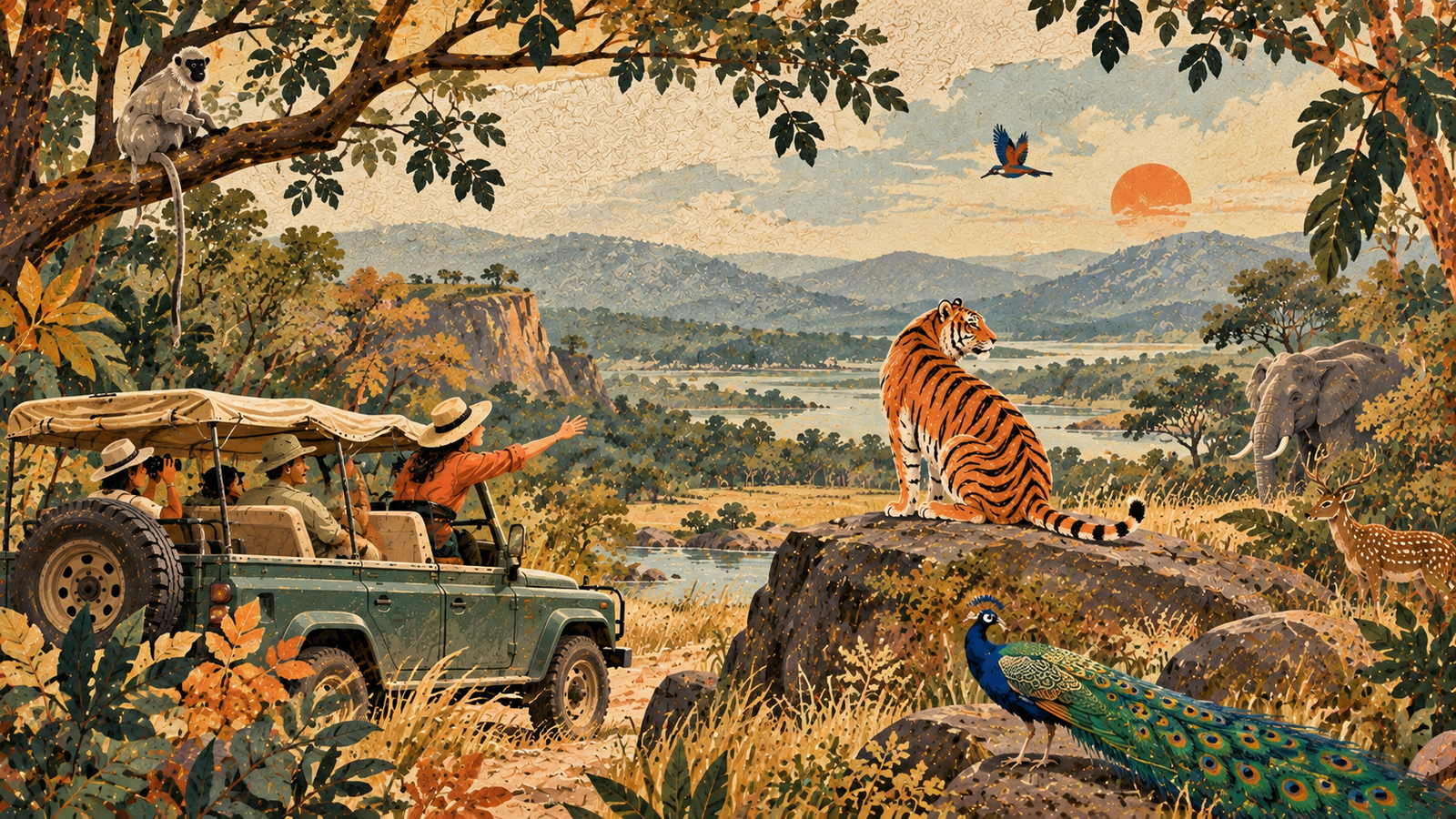
After a rather prolonged silence, I was gently informed that it wasn’t permissible for me to even leave the safari vehicle.
“You are not joking?”
I said, “What if the tiger wants to talk to me?”
Apparently I’m not even supposed to stick my hand out of the jeep. Disappointing, I had already pictured myself giving one of the tigers a good scratch behind the ears and going home an accomplished wildlife influencer.
Then another idea struck me. “What if,” I whispered, “ I pay the guide a little extra… and we go straight to wherever the tiger is?” The guide sighed. This wasn’t a normal sigh. It was the kind that implied he’d probably heard this question many times before.
He explained how many visitors try to do this; offering money to guides in the hopes that they might get to see “the big cat.” He added, however, that it turns a perfectly calm safari into a dangerous chase; cars darting around trying to force an animal to perform on cue when they owe nobody an appearance fee.
“Besides,” he said, “wildlife doesn’t really work like that.” I wasn’t buying it, though. “So… you at least know where today’s tiger is?”
“No.”
“But you’re the guide.”
“Precisely.”
He explained that guides spend years understanding the behaviour of animals, reading alarm calls, following tracks, observing the forest and respecting its rhythms. They try their best to give every visitor an unforgettable wildlife experience, but nature doesn’t run on appointments.
Apparently, the tigers had never received my calendar invite.
Never willing to be defeated, I had one last ingenious plan.
“What if I bring my pet cat?”
“You know… as bait.” That was the quickest “no” of the day. Pets, I was informed, are not allowed in national parks or tiger reserves, a rule designed to protect both the wildlife and my very confused house cat.
I felt personally insulted. I explained I knew the protocols of the jungle perfectly well.
“I’m not going to litter.”
“Good.”
“ I’m not going to throw plastic.”
“Okay.”
“I’m not going to smoke.”
“Wonderful.”
“I’m not going to light a campfire.”
The guide looked at me.
“Why would you light a campfire?”
“I don’t know… I’m just listing things I promise not to do!”
He thanked me for not trying to invent new forms of criminal behaviour.
Then he said something which was utterly unexpected: “You have come to the wrong place.”
I scoffed.
“I came for a tiger!”
“Precisely,” he said with a smile, pointing towards the forest. “This is not a tiger show. It’s a forest.”
I wanted to argue. I really did. I had at least seven more brilliant ideas, including disguising myself as a deer and learning to communicate through pspspsps. But judging by the guide’s expression, he’d already heard them all from someone else.
So I surrendered.
Fine. I’d do the safari their way.
No petting tigers. No bribing guides. No emotional bonding with apex predators.
A few days later, I found myself squeezed into the jeep behind two very experienced guides, who proceeded to drive slowly, never honking, never cornering too fast, never treating it as if it was the Jungle Grand Prix.
Unlike me, they knew the jungle was not in any hurry. Naturally, being the environmentally conscious tourist that I was, I put my phone on silent, keen not to announce my presence with every vibration and chirp to every creature within a one-mile radius.
I kept checking it for the first fifteen minutes. No service, no messages, no social media notifications. Pure, unadulterated boredom drove me to look up. That’s when I saw it.
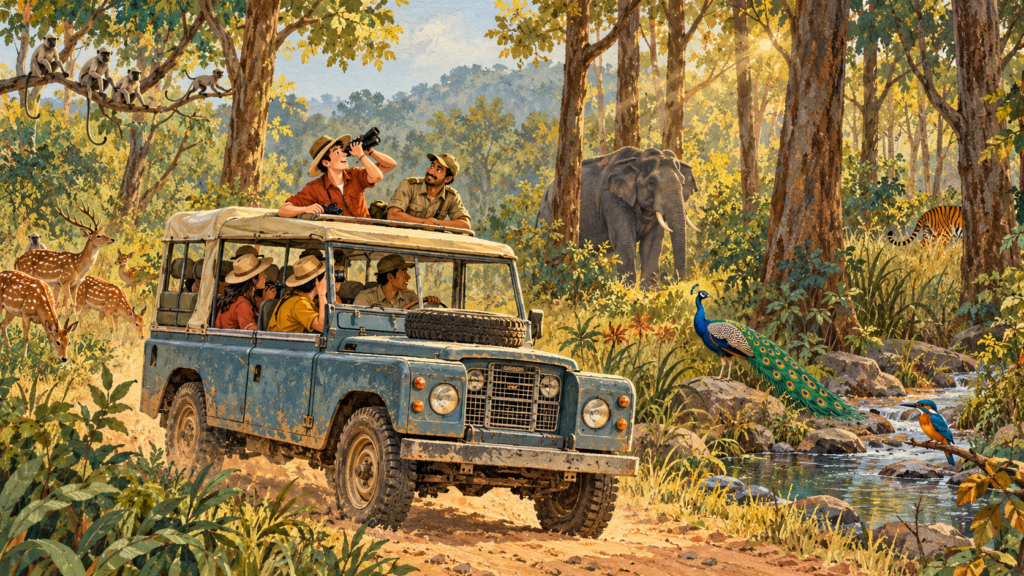
The forest; sunlight was streaming down through gigantic sal trees, troops of langurs were arguing over breakfast, kingfishers were flashing like living jewels over streams, spotted deer grazed placidly whilst peacocks strutted around as if they owned the place, which, come to think of it, they probably did.
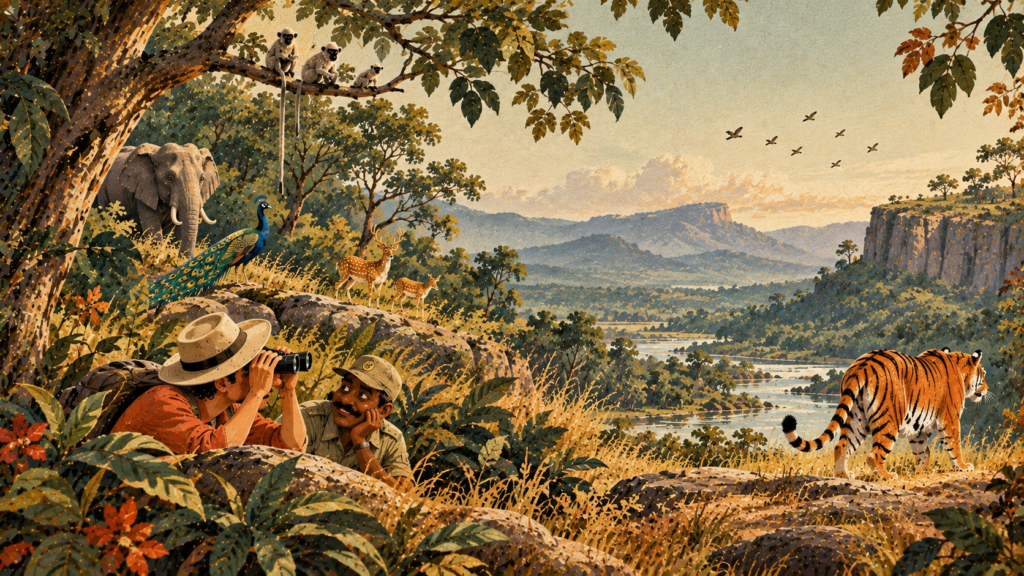
At some point, I realised something embarrassing. This entire time, the forest had been playing out in real time. I had simply failed to watch it.
In another jeep nearby, one gentleman was quietly reaching out for a cigarette. Before he could take it out, the guide casually informed him, “ Not in the jungle.”
Then came another group of tourists.
They laughed loudly at the monkeys.
Tried to scare a herd of deer just to make them run.
Complained that birdwatching was boring because they “see birds every day.”
I couldn’t believe what I was hearing. Just a few hours ago, I’d have said the exact same thing.
Now, however, I was captivated by the birds, by the alarms of the unseen animals, by elephants silently melting into the trees. And I was wondering about the stories that the jungle could tell, with or without a tiger appearing as a special guest.
By the end of the safari, we still hadn’t seen a tiger. If it were the ‘old’ me, I’d have been utterly disappointed. But instead, I realised this: I’d spent the whole time trying to get the forest to perform for me. But that’s not what a safari is for. It’s not about ticking a tiger off your list. It’s about walking into someone else’s home as a guest, making as little impact as possible, observing and absorbing everything.
Would I have loved to have seen a tiger? Without a doubt. Would I still have liked to have petted one? Let’s just say there are some dreams better left at the fantasy stage.