In 2010, football ads felt like love letters to the game.
They were not directed at brands, products, or even players, but rather at football itself.
The streets mattered; the neighborhoods mattered; the local pitch mattered. The kid trying to recreate a Ronaldinho skill move mattered.
When Nike released “Write The Future” before the 2010 World Cup, people didn’t remember it because it sold boots. They remembered it because they understood what football felt like. A single moment has the power to transform a life. One goal could create a hero. One penalty from the opponent team could haunt the nation.
The product was almost secondary; the game carried the weight and the emotions, and it was the story.
I, myself, have always been interested in ad campaigns since I was a kid, and now, 16 years later, football advertising feels entirely unique.
The visuals keep getting sharper, which is a good thing; the budgets are bigger. The celebrity lists are longer.
Yet somewhere along the way, football stopped being the center of the conversation.
And perhaps that is why Adidas’ FIFA 2026 campaign has generated such an intriguing reaction, not because it reinvented football marketing, but because it reminded people of something they thought had disappeared.
The World Cups of 2010 and 2014 arrived during a unique period when football wasn’t competing with TikTok or with short-form content either. Football wasn’t competing with TikTok, nor was it competing with endless short-form content or with algorithms.
Football was the culture. The advertisements reflected that reality. Brands borrowed stories from football because football already possessed cultural power. Even when campaigns featured global superstars, they often felt connected to ordinary fans. The audience could still see themselves in the story.
The professional player represented a dream. Not a product placement.
But the essence of it started to change around the late 2010s. Football marketing became bigger than football itself. Campaigns became cinematic events.
The result was spectacular content, but often hollow. The sport became a backdrop, and to chase the mass aesthetic replaced emotion, virality replaced community, and attention replaced meaning.
Many campaigns were technically impressive but oddly forgettable; you could recall the camera angles and production quality, but not how they made you feel. The advertisements were no longer documenting football culture. They were manufacturing cultural moments designed for social media and produced for the masses to gather them to sell their product, and just by chance, football happened to be the vehicle.
To make things feel different, Adidas made its campaign extremely engaging for 2026, titled “Backyard Legends.”
On paper, it sounds like everything is wrong with modern marketing: a Hollywood actor, a global music superstar, football legends, and a reported blockbuster budget.
Timothée Chalamet, Lionel Messi, Bad Bunny, David Beckham, Jude Bellingham, Lamine Yamal, Trinity Rodman, Zinedine Zidane, and others all appear in the campaign. The film deliberately blends football, music, film, and internet culture into one giant cultural crossover.
That sounds less like World Cup 2026 and more like an Avengers movie. Yet the campaign works for a surprising reason. Its story is not actually about celebrities. Its story is about a local pitch.
The central idea revolves around an unbeatable neighborhood team that has defended its ground for decades. The world’s biggest stars become visitors to a story that already existed before they arrived.
Backyard Legends treats the fan as the origin point. The greatest football story is not presented as a World Cup final. It is presented as a game happening somewhere down the street. That idea feels surprisingly old-fashioned. And perhaps that is precisely why people responded to it.
The most intriguing reactions are coming from ordinary viewers. Across Reddit and social media discussions, reactions reveal a pattern:
“This ad is so good! I’m amazed by it. Timothée with the football GOATs is pretty cool.”
Some viewers loved the campaign because it felt nostalgic and fun. Others praised the idea of seeing multiple generations of football represented together. Several comments described the film as feeling more like a short movie than a commercial.
But criticism appeared as well.
Some viewers questioned whether the campaign relied too heavily on celebrity culture. Others joked about the existence of a “trailer for an advertisement.” Some felt the production was almost too polished and too self-aware.
Interestingly, both groups are reacting to the same thing. People are no longer evaluating FIFA World Cup advertisements as advertisements; they are evaluating them as cultural events. The campaign itself becomes part of the conversation. The advertisement becomes its entertainment product.
In addition to all the cultural celebrations, I believe the campaign raises a broader question. What role should football advertising actually play? Should it celebrate football culture? Alternatively, should football advertising focus on creating a new culture surrounding the sport?
For years, brands have been moving toward the second option. Football is no longer just a sport. It sits at the intersection of music, fashion, film, gaming, and internet culture.
Adidas clearly understands the situation. Its2026 campaign intentionally combines all of those worlds into a single ecosystem rather than treating football as a separate category.
The strategy makes perfect sense. The modern fan experiences football through Instagram, YouTube, podcasts, memes, and creators.
Football no longer lives exclusively inside stadiums. Yet, when every cultural experience turns into content, we lose something valuable. The risk is that football starts serving marketing rather than marketing serving football.
There was another campaign that caught my attention this year.
This campaign caught my attention not because it reminded me of football, but because it highlighted how far football advertising has evolved.
Nike’s 2026 World Cup campaign felt like the complete opposite of Adidas’ approach.
The campaign brought together Cristiano Ronaldo, Kylian Mbappé, Erling Haaland, Vinícius Jr., LeBron James, Travis Scott, Kim Kardashian, and a collection of celebrities from entirely different worlds.
At times, it felt less like a FIFA World Cup advertisement and more like a trailer for the biggest entertainment event on Earth, and maybe that’s precisely what Nike wanted.
Because FIFA in 2026 has become a fashion, a display of music, and the largest paycheck officials can see.
Remember, in cartoons, the dollar sign shines brightly. Just. Like. That.
FIFA has become one giant cultural ecosystem, and Nike’s campaign embraced that reality without hesitation. The production looked expensive, and yes, I mean it; you’ve read the “names.”
And strangely enough, the reactions online revealed something intriguing: many people loved it. It was not because it felt authentic, but rather because it felt fun. Comments across social media described it as chaotic, entertaining, cinematic, and larger than life. People enjoyed seeing different worlds collide: the world of football and pop culture.
Everyone had something to talk about, but another group of people seemed unconvinced. Many fans questioned why football advertisements now need celebrities who have little connection to football.
Others joked that modern campaigns feel like movies trying desperately to become memes. Some felt football was becoming a supporting actor in its story.
Both reactions make sense.
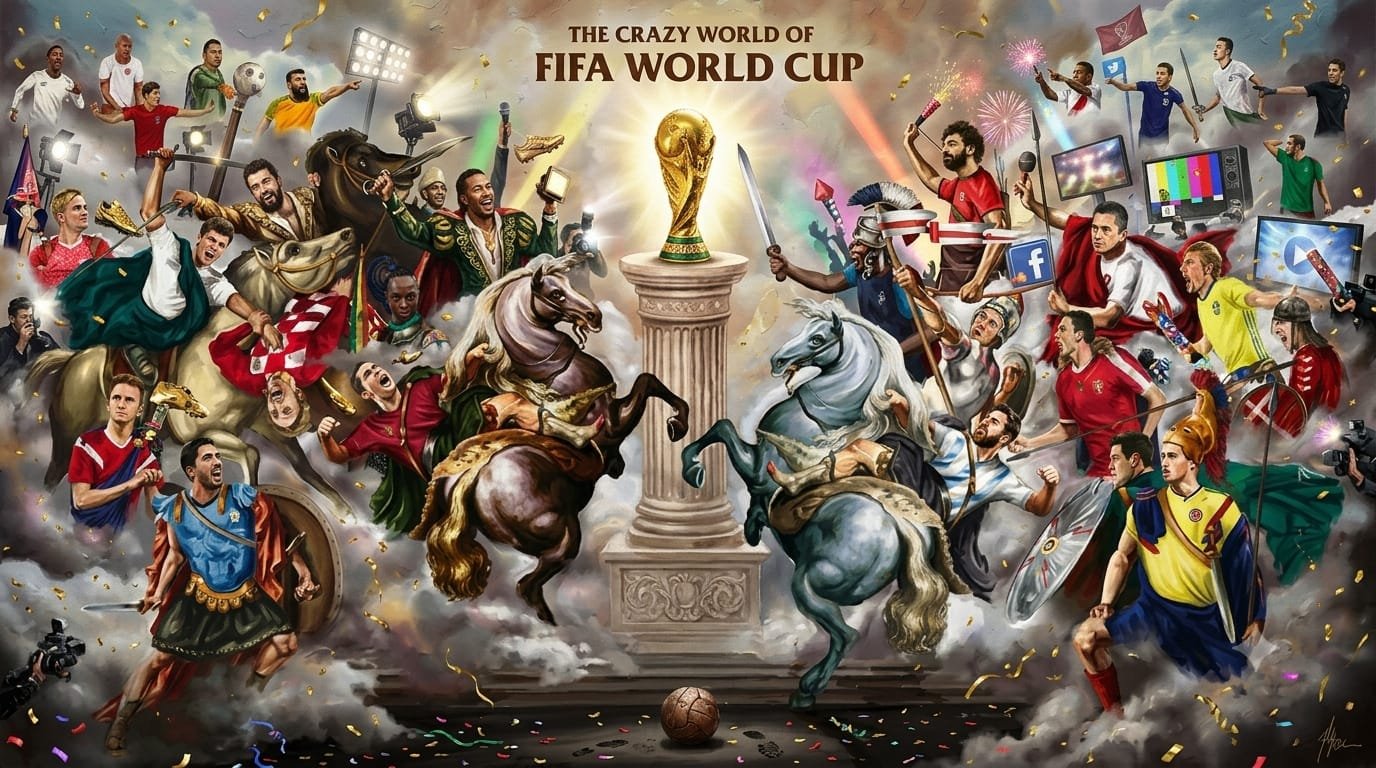
Nike’s campaign exposed the identity crisis that World Cup advertising is currently experiencing. One side sees football as a culture. The other sees football as entertainment.
The contrast is quite interesting, as you find it becomes impossible to ignore when you place Nike next to Adidas.
Adidas looked towards nostalgia by unlocking memories and evoking the sentiment of, “Remember those days?”
In contrast, Nike celebrated both celebrity culture and internet culture.
Towards the reality of how modern audiences consume sport. One campaign asked us to remember football. The other asked us to imagine what football could become.
If you absolutely want another example besides Adidas, use Puma, not because its campaign was bigger, but because it felt smaller, and that’s precisely why it worked.
While most brands were competing for attention, Puma spent much of its World Cup communication talking about football communities, local culture, supporter identity, and the emotional connection people have with clubs and national teams.
There were fewer attempts to create a viral moment, fewer attempts to dominate the internet for a week. Instead, the messaging felt closer to what football used to represent. These are the kinds of moments that occur long before a camera arrives, highlighting the irony of World Cup advertising in 2026.
Football’s greatest advertisements were never remembered because they sold products. They were remembered because they captured something true.
Yes, the technology has improved dramatically since 2010; yes, the budgets are larger; yes, the productions are more ambitious. Yet fans still respond most strongly when campaigns return to the simplest idea in football:
Adidas’ 2026 campaign does not fully reverse the commercialization of football; no advertisement can do that. But it does reveal something important. After years of chasing spectacle, audiences still seem to be searching for the same thing they were looking for in 2010.
Not bigger stars, not better visual effects, not more famous faces. Just a reminder of why they fell in love with football in the first place.