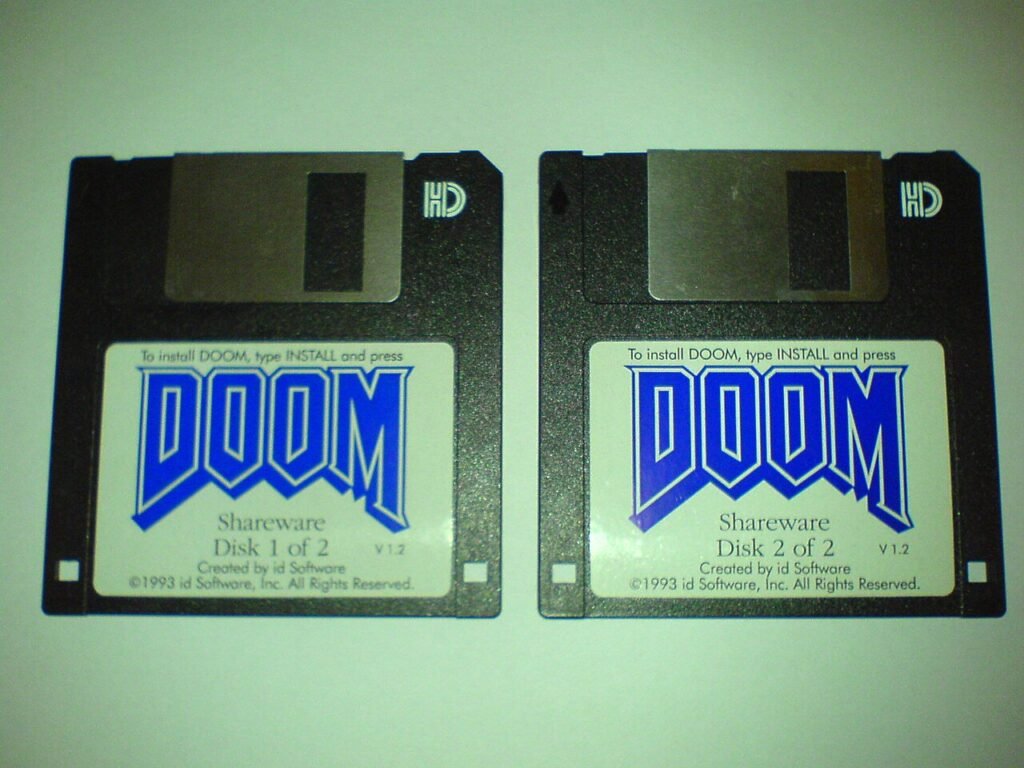
What if I tell you, there’s a game that can ‘run’ on a pregnancy test kit? No, I’m not hallucinating. I’m not ChatGPT or Claude.
And while I was writing this article, I found out that (as if running this game on a display made up of E. coli bacteria was not enough), some mad scientists got it running on Neurons.
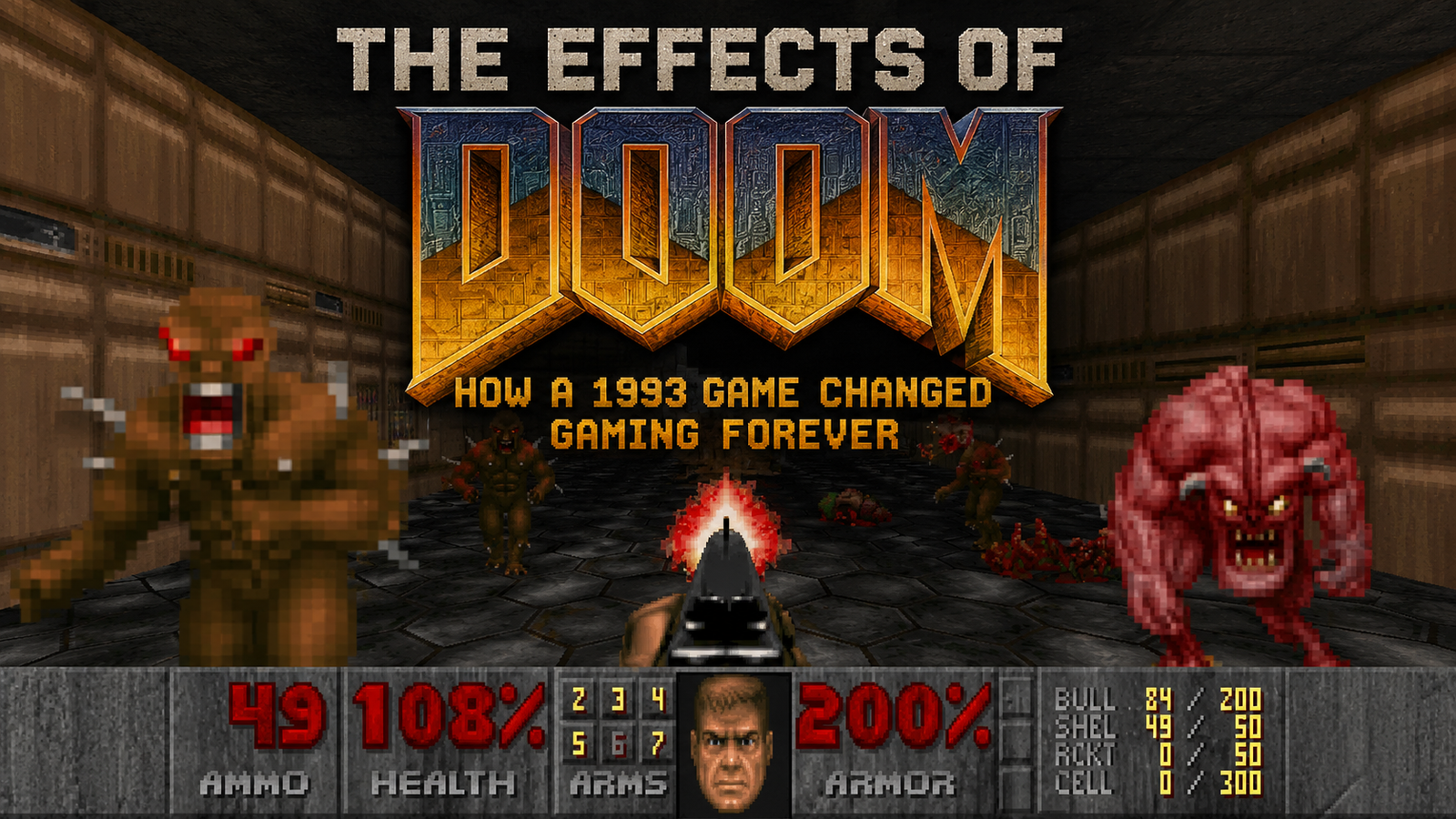
DOOM was and is a revolution, no matter how you look at it. Even after 33 years post its release, it still holds a sacred space in our gaming industry.
By no means it was the first in its genre. That crown (technically) rests with Wolfenstein 3D (1992). But DOOM in its entirety was nothing short of an earthquake that defined most of what the FPS (first-person shooter) genre in our gaming industry.
As a kid who grew up with Contra and later Project IGI, Counter Strike and even Call of Duty, I actually never got the chance to try the original Doom on ana MS-DOS system running an Intel i386. That was before my time. Oh I wish I was alive to witness that, but that’s besides the point.
DOOM was actually very unique and simple in its implementation but a product of genius. Rather the collective genius of the team at id Software. Not just the technical side of it, but also the vision behind it, its execution and the aftermath.
I’ll explain why.
“Back then rumour had it that your Catholic granny and Pastor Jerome in the next street loved the game. After all, it’s about killing demons. Very Christian indeed.“
The guy leading the charge was John Carmack, the legendary programmer & co-founder of id Software. The original team that worked on the ‘Doom Concept’ in late 1992 consisted of just 5 guys (who may or may not like eating at Five-Guys), shutting themselves off in a dark office suite, aptly naming it ‘Suite 666’ and drawing inspiration from the commonly known concept of ‘hell’ and ‘demons’ – which was reflected in their art-style and choice of soundtrack.
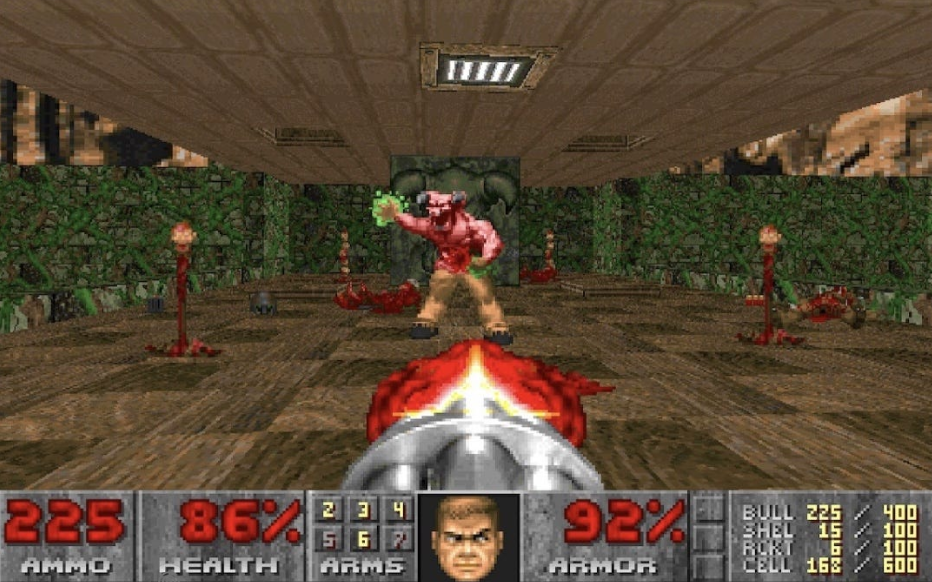
The concept or the ‘plot’ was actually simple. A fast-paced first-person shooter, where you’re a space marine posted on a dead-end assignment on Mars. Some teleportation experiment goes wrong and a portal to hell is opened up on the moons of Mars. Our protagonist, fondly dubbed ‘Doom-guy’ by fans later on, is no short of a one-man army and proceeds to slowly eradicate the demon population while fighting huge beings called ‘Barons of Hell’ and the story ends (spoiler alert) with a portal to Earth, which is now also infected. This loop is simple and efficient and mostly fun. You don’t care much about the ‘how’ and the ‘why’, all you care about, as the player, is “Rip-and-Tear”. Fun right?
Back then rumour had it that your Catholic granny and Pastor Jerome in the next street loved the game. After all, it’s about killing demons. Very Christian indeed.
Coming back to its core development. The versatility of the code itself, coupled with the tenacity of the developers is the reason why DOOM is the ‘father’ of FPS genre. Complex narrative was dropped in favour of making the game fast-paced and not wasting the User’s time on character-driven plot. This became a forte and a style-statement for id Software in the years that followed. A fellow programmer in the team, John Romero, reworked the level design to make it more fluid and actually show the game engine’s capabilities.
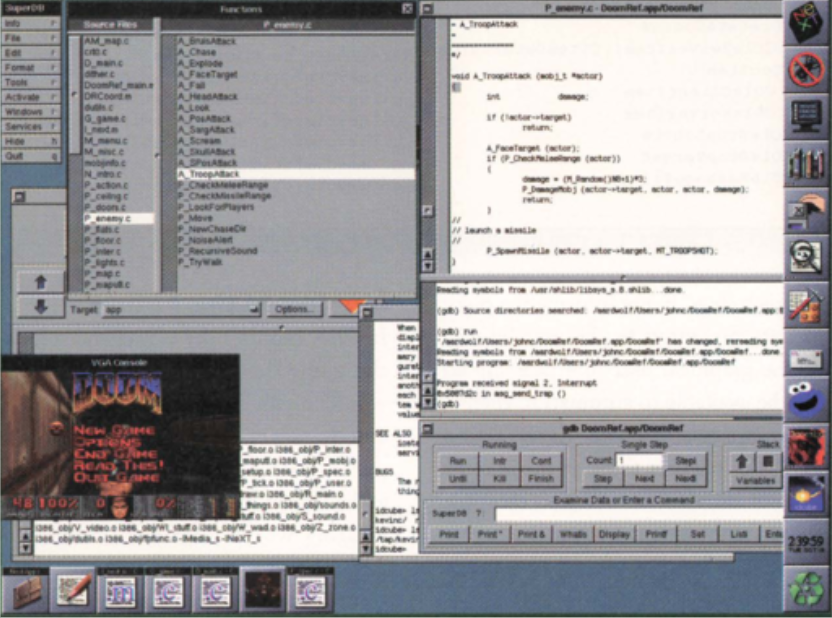
For the custom written game engine, which was later affectionately called the ‘DOOM Engine’, (and to no one’s surprise) the mantle rested with the C Programming Language with a drizzle of x86 Assembly on top. But on what hardware? Well, do you remember Steve Jobs? Of-course you do. But do you also remember that he was fired from Apple in the late 80s and formed his own company called ‘NeXT’ and they started pushing their NeXT Computers running the ‘NeXTSTEP Operating System’. Well, that’s what Carmack and his team used.
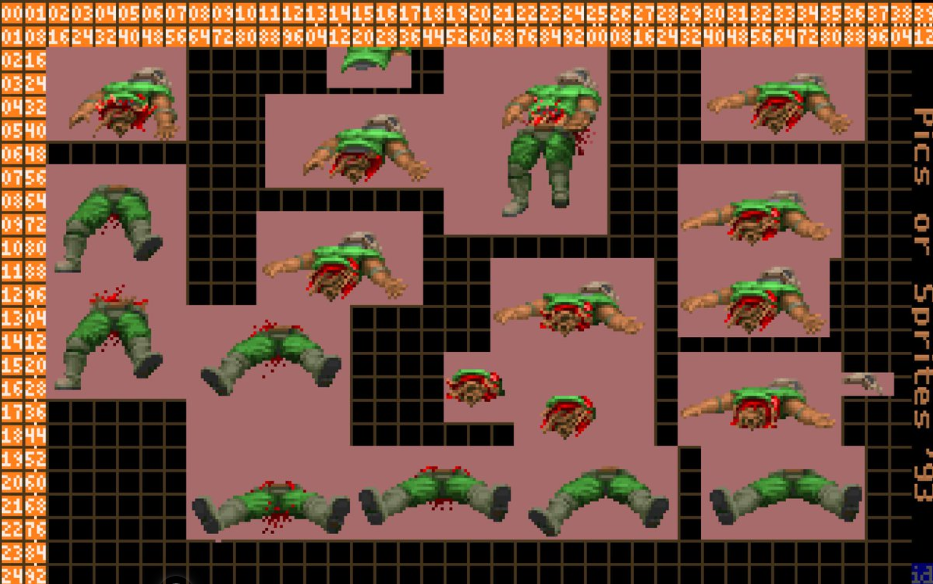
Adrian Carmack (no biological relation to John Carmack btw – crazy I know !) was handling the art for DOOM. Without going into much detail, the demons were sculpted, their images were captured, their motion digitized via ‘stop-motion’ technique and then digitized as 2D sprites to be pushed in the game’s code.
It was called 2D by normies but in reality it was ‘2.5D’ where the environment is 3D-looking but the enemies and objects are actually 2D sprites (aptly named ‘billboarding’). Apart from the ‘nightmare-ish’ style of the monsters/demons, the music was chosen to be styled like techno & metal – goes without saying it went perfectly with the ‘tone’ of the game.
Without boring you to death with how the lighting system was implemented in the DOOM Engine, I’d encourage you to read this. TL;DR – it was a clever trick to make an ‘illusion’ of day or night times and how the light ‘would’ cast itself on nearby surfaces. A month before release, Carmack set out to code the most (and emphasize on ‘most’) important aspect of this game – something that is now as synonymous with the FPS genre as Apple is with premium devices – “Multiplayer”. This component alone was what set out DOOM as something entirely unique. Every FPS game that followed since then has had something of this sort. Even the ones you grew up with. The likes of Quake, Unreal Tournament and even Counter Strike 1.6. Later on, Romero coded the four-player multiplayer system, inspired by fighting games like Street Fighter II – dubbed ‘Deathmatch’ – and this word slapped itself onto the gaming industry like flex tape on a leaking water tank. God bless John Romero.
The business team of id Software was actually just one guy. No surprise there. But he planned the marketing and decided to leverage the “shareware” system for the game sales. The first level of DOOM was basically given away for free – via Software retailers and even players – in the hopes of them acquiring the full copy and making the efforts of id Software worthwhile. The business guy, whose name is Jay Wilbur, felt that the mainstream media is not ‘interested’ in such a game and hardly bought any Ads in the game magazines. A bold move I must say.The game finally released after a few months of crunch near the end of 1993. That was also when the nascent internet was slowly taking its shape, and id Software only gave one interview and decided to put some updates ‘out there’. Exciting times they were. id Software later published the entire first episode online and even connected to a University server – which was actually a bonkers thing to do as the server crashed 30 minutes after the upload due to the 10,000+ students trying to download it all at once. The good thing was that John Carmack realised the network optimizations he needed to implement for it to stop crashing the networks it was deployed upon.
What followed this mega-hit of a video game was a barrage of ‘ports’. For the un-initiated, unlike the type-C charging port on your phone, a ‘port’ also refers to a program being ‘ported’ or translated from one type of system to the other. A game ported from Windows to MacOS for example. Anyways, DOOM was given an unofficial Linux port by one of the in-house developers. Bill Gates wanted a port for his Windows 95 Operating System – thought of acquiring id Software but was politely declined – so he tasked one ‘Gabe Newell’ to make an officially licensed port (will recite the story of this ‘Gabe’ some other day). Since then, DOOM was also ported to the Super NES, Playstation in 1995, Sega Saturn, Nintendo GBA, Xbox 360 in the mid 2000s, iOS, Nintendo Switch, Xbox One, PS4 and even on Android in the mid 2010s.
The source code – which many game developers and programmers are still grateful for – was released in 1999 under public license, post which the ‘crazy’ ports have come to exist – akin to the pregnancy kit-port that I alluded to at the start of this article.
I don’t need to go into the reviews and reception of this game, you can easily gauge the idea from this entire article. (Yes Billy, it was an ‘overnight hit’ and had ‘glowing’ reviews from all major gaming press. Now please continue reading will ya, Billy?).
Suffice it to say, critics also dragged this title and medical professionals tried calling it a ‘source of aggression among players’ – a subject heartily embraced by politicians who can’t differentiate between Mac or Windows but are deemed fit to make rules for us from behind their thick glasses and their grey hair (sigh).
But overall, DOOM is a study on its own. The clean modular C code, the Assembly modules, minimal memory overhead, the clever 2.5D rendering, the fixed-point math, the data-driven design, the Binary-space partitioning, the genre-defining moment it held, the games and the innovations it gave birth to and paved the way for, the capacity it holds to be ported to literally freaking human cells, talks volume of this miracle that five guys started to conjure in a dark suite in a dark building with a dark desire of defeating some dark demons while some dark music plays in the backgrounds.
And somewhere or the other, it still shows. id Software, even now produced the recent DOOM titles which can run really well on older hardware, and can be made to reach their engine frame-rate cap of 1000FPS in certain cases.
Perfection. Attained 33 years ago, still glistening the entire industry with its grandeur.
THE
GOODDAY POST
CREDITS
Paradoxical95
Author
Hassan
Editor
M Khizar
Editor
Dimpy Malviya
Contributor
Support Us
We believe happiness is contagious. Your support allows us to keep digging for the stories that restore faith and spark a smile.